Disclosure: Some links on this page are affiliate links. Commissions never change our recommendations. Read the full disclosure.
Last updated
Reviewed May 15, 2026What most owners actually need
Five accessories show up across almost every long-term ownership setup because they solve real, persistent problems. Buy these first; everything else is a refinement.
Must-have - condensation control
Anti-condensation mat - $40 to $90
Solves the single biggest comfort problem with rooftop tents. Sits between the tent floor and the mattress and breaks the cold-floor bridge where condensation forms. Manufacturer mats are sized to specific tent floors; aftermarket equivalents are fine if the dimensions match. If you sleep two adults in a rooftop tent, this is the first accessory to buy.
Must-have if vehicle is tall - safer entry
Ladder extension - $80 to $180
Required on most lifted trucks and full-size SUVs to keep ladder angle under 70 degrees from vertical. Manufacturer extensions ship pre-fit; aftermarket extensions require careful matching to ladder profile and step spacing. On any tall vehicle, budget the extension at the same time as the tent rather than adding it after the first uncomfortable climb.
Must-have - in-tent lighting
Headlamp with red mode - $20 to $50
A small headlamp with a red-light mode handles every in-tent task without draining the vehicle battery and without ruining your night vision when you climb down at 2 a.m. Look for USB-rechargeable models with a 200-400 lumen white mode and an honest battery life of at least 30 hours on low.
- Better pillow and bedding upgrade ($50 to $200). A real pillow and a fitted sheet for the built-in mattress is the cheapest upgrade that meaningfully improves sleep. Most built-in mattresses are 5 to 10 cm of foam, which is acceptable but not great as shipped.
- Shoe bag or vestibule storage ($25 to $80). A hanging shoe bag keeps boots out of the bedding. Sounds trivial; saves the bedding from mud after one wet night.
Condensation control
Condensation is the comfort problem owners underestimate the most. It forms where warm bodies meet the cold tent floor, not just on the walls. Two campers can put roughly half a liter of moisture into the tent body overnight through breathing alone. That moisture pools under the mattress and migrates back into bedding by morning unless you actively manage it.
The standard fix is mechanical, not chemical: an anti-condensation mat between the tent floor and mattress, plus at least two windows you can open simultaneously even in rain. The mat moves the dew point away from where you sleep and lets airflow move the moisture out instead of letting it soak in. Heated rooftop sleeping is possible with electric pads or hot water bottles, but never with combustion heat inside the tent body; carbon monoxide concentrates fast in a sealed fabric volume.
Ladder extensions and safer entry
Stock ladders are sized for the median crossover or mid-size truck. On lifted trucks, full-size SUVs, or any vehicle parked on the downhill side of a campsite, the ladder angle becomes too steep for safe and comfortable use. The threshold is roughly 70 degrees from vertical; past that, climbing in becomes a leaning-forward motion that is harder for older or shorter campers and risky in the dark or wet.
Manufacturer ladder extensions are the right answer in most cases. They are pre-fit, pre-tested for load, and warranty-covered. Aftermarket extensions are cheaper but require careful matching to the ladder's profile and step spacing. Add a small step or traction mat at the bottom of the ladder for camp setups on soft ground; it is a $20 fix for the second-most-cited entry problem.
Bedding, toppers, pillows, and pad insulation
Built-in rooftop tent mattresses are functional but not great. The two highest-value bedding upgrades are a fitted sheet sized to the tent's mattress and a real pillow. After those, the next most useful upgrade depends on climate. In cold weather, a thin closed-cell foam pad inside the tent (on top of the built-in mattress) adds R-value where it matters most. In warm weather, a moisture-wicking topper improves comfort more than insulation does.
Sleeping bags or quilts inside the tent are the same gear you would use elsewhere. The pad and insulation guide covers insulation choices, pad R-value, and quilt-versus-bag tradeoffs in detail.
Shoe bags, gear lofts, and small storage
Two pieces of small storage solve most in-tent friction. A hanging shoe bag below the door keeps boots out of the bedding. A gear loft above the sleepers holds headlamps, eyeglasses, water bottles, and chargers. Both are inexpensive and nearly universally worth it.
Larger annex storage rooms attach below the tent body and add a covered gear area at ground level. They are worth it for basecamping families and overlanders who spend multiple nights at one site; they are dead weight for one-night road trippers.
Lighting and power
Tent interior lighting choices come down to brightness, run time, and battery impact. The standard answers are:
- Headlamps for in-tent tasks (reading, getting dressed, finding gear). Look for red-light modes for lower visual disruption.
- Small USB-rechargeable lanterns for ambient light and hangouts. 200 to 400 lumens is plenty for a two-person tent.
- 12V rack-mounted strip lights for setup-area lighting at the campsite, not inside the tent. Wire through a switch to avoid drain when parked.
For sustained off-grid lighting and charging, plan power at the vehicle power hub, not at the tent. Tent-attached power solutions are usually a worse answer than a portable power station kept inside the vehicle.
Awnings, annexes, and weather entry
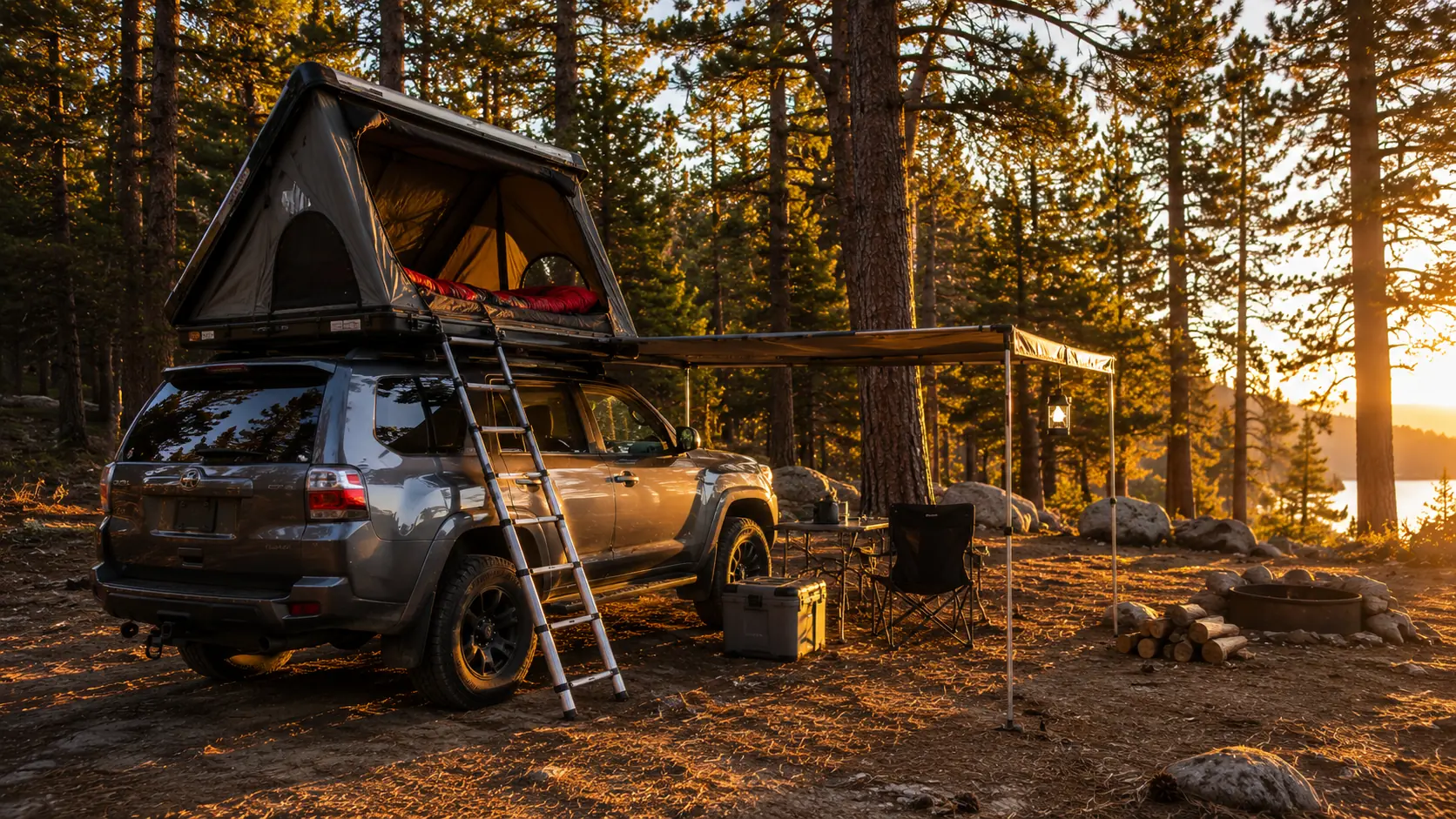
Awnings extend the campsite, not the tent. A side or rear awning gives you a dry standing area for cooking, a shaded spot for hot afternoons, and a place to dry gear. The biggest decision is mount location: rack-mounted awnings work even when the tent is closed; tent-mounted awnings only work with the tent open. Rack-mount is the more flexible choice for owners who use the awning when the tent is not deployed.
Annex rooms are essentially a fabric room that hangs below the tent body. They add a changing space, gear storage, or bug protection at ground level. Their real cost is setup time; they roughly double the time it takes to deploy a softshell tent and they slow pack-down meaningfully. Buy an annex if your routine basecamps for two or more nights at a time. Skip it for one-night road trips.
What to skip at first
- Full annex for one-night road trips. Setup time outweighs the benefit. Reconsider when your trip pattern shifts to multi-night basecamps.
- Expensive hardwired lighting. Wait until you know your camp routine. A USB lantern usually answers the same need.
- Duplicate storage bags. The shoe bag plus a small gear loft covers most in-tent storage needs.
- Heavy accessories that push roof load too close to the limit. Awnings, lights, and fuel cans add up. Re-run the fit checker after meaningful accessory additions.
- Accessories that block hatch, ladder, or awning access. Trial-fit anything large before you commit to mounting it.
Accessory budget examples
- Minimum comfort upgrade ($150 to $250): anti-condensation mat, better pillow, small light, basic shoe bag.
- Tall vehicle upgrade ($250 to $450): ladder extension, step or traction mat for ladder base, shoe bag.
- Rainy climate upgrade ($300 to $600): anti-condensation mat, rack-mount awning, dry-entry storage, small lantern.
- Family basecamp upgrade ($600 to $1,200): annex room, bedding upgrade for everyone, gear loft, lighting.
- Winter or shoulder-season upgrade ($400 to $900): better pad and bedding, condensation control, insulated tent liner if your tent supports one.
Best next step
- Confirm rack and tent capacity headroom in the fit checker before adding heavier accessories like awnings or lights.
- Plan bedding insulation alongside the sleep systems hub to avoid buying duplicate or contradictory gear.
- Cross-check awning, rack-light, and storage choices in the vehicle accessories hub.
Frequently asked questions
Do I really need an anti-condensation mat?
Are awnings worth it for a rooftop tent setup?
When does a ladder extension actually become necessary?
Do I need an annex room?
How much should I budget for accessories total?
Where should accessory weight count against my rack rating?
How we wrote this
A synthesis guide, not a hands-on review
This guide groups accessories by the problem they solve, not by brand. Recommendations come from manufacturer accessory pages, REI sleep-system guidance, rack manufacturer weight rules, and what owners actually report. Specific products are mentioned only when they are the standard reference in the segment, and we explain who should not buy them too. Affiliate buttons go to Amazon search so prices and availability stay current.
We have not field-tested every product mentioned. Where we describe a product we are synthesizing manufacturer specifications, independent expert reviews, and verified user feedback from forums. Sections will be replaced with first-hand notes once testing is complete. Read our full methodology.
References
Sources synthesized to write this guide. Manufacturer pages cite specifications; independent publications and forums cite real-world performance and failure patterns.
-
Manufacturer-grade accessories, ladder extensions, anti-condensation mats, and annex specifications.
-
Manufacturer reference for anti-condensation mat sizing, awning brackets, and ladder extensions.
-
Annex, awning, and bedding accessory range for Tepui-line tents.
-
Budget tent annex, ladder, and replacement-part accessories.
-
Independent guidance on bedding insulation and sleep-system layering used in this guide.
-
Rack manufacturer guidance for accessory weight when added to an already-loaded rack.
-
How added accessories count toward dynamic and static load with examples.
-
Owner discussions on which accessories solved real problems and which did not.