Disclosure: Some links on this page are affiliate links. Commissions never change our recommendations. Read the full disclosure.
Last updated
Reviewed Aug 13, 2026Looking for something else? If you want one shared bed for two adults or a mattress shaped around a cargo floor, the car camping mattress shortlist is the better page. If you have not settled on a surface type yet, start by weighing cots against pads and air mattresses. If the pad is already chosen, the sleep setup walkthrough covers bedding, airflow, privacy, and the morning reset.
Start with R-value, then comfort
R-value measures resistance to heat flow. Since ASTM F3340 standardized sleeping-pad testing, major brands can be compared more honestly than they could a decade ago. For vehicle camping, there is little reason to buy a summer-only pad unless you only camp in warm weather.
| Expected low | Minimum pad R-value | Better car-camping target | Notes |
|---|---|---|---|
| Above 50F / 10C | R 1-2 | R 2+ | Summer-only setups can be simple |
| 30-50F / -1 to 10C | R 2-3 | R 3+ | Most three-season car camping |
| 20-30F / -7 to -1C | R 3-4 | R 4+ | Cold sleepers should size up |
| 10-20F / -12 to -7C | R 4-5 | R 5+ | Stack foam under inflatable for backup |
| Below 10F / -12C | R 5+ | R 6+ | Winter system, not a single-product decision |
Sleeping pad R-value targets
Above 50F / 10C
- Minimum pad R-value
- R 1-2
- Better car-camping target
- R 2+
- Notes
- Summer-only setups can be simple
30-50F / -1 to 10C
- Minimum pad R-value
- R 2-3
- Better car-camping target
- R 3+
- Notes
- Most three-season car camping
20-30F / -7 to -1C
- Minimum pad R-value
- R 3-4
- Better car-camping target
- R 4+
- Notes
- Cold sleepers should size up
10-20F / -12 to -7C
- Minimum pad R-value
- R 4-5
- Better car-camping target
- R 5+
- Notes
- Stack foam under inflatable for backup
Below 10F / -12C
- Minimum pad R-value
- R 5+
- Better car-camping target
- R 6+
- Notes
- Winter system, not a single-product decision
R-value stacks, so you may already own the upgrade
Here is the thing almost no product page will tell you, because it does not sell a pad: R-values add up. REI states it plainly in its own buying guide - "if you want to calculate the total insulation for stacked sleeping pads, simply add their R-values" - and Therm-a-Rest says the same thing about putting a foam pad under an air pad.
That turns a purchase into arithmetic. If the table above says you want R 5 for a 20°F night, you do not necessarily need an R 5 pad:
- R 2 closed-cell foam + R 3 inflatable = R 5 system - and if you already own a three-season inflatable, the missing piece costs about $55.
- R 3 inflatable alone on a 20°F night is two full points short, which is what "my pad is thick but I was cold" usually means.
- Foam goes underneath, not on top. It insulates either way, but underneath it also takes the grit and the dog claws, keeps ground moisture off the inflatable, and leaves you with a usable bed if the air pad fails at midnight.
Two practical notes. Match the lengths, or the gap becomes a cold spot exactly where your feet are. And the arithmetic only holds because ASTM F3340 made the numbers comparable across brands - a pre-2020 pad with a marketing R-value is not necessarily measuring the same thing.
Measure your shoulders before you choose a width
Width is the spec people notice last and complain about first, and it is the easiest one to get right because it is pure geometry.
Standard pads come in three widths: 20 inches (the backpacking default), 25 inches (usually sold as "wide"), and 30 inches or more on car-camping models. A 20-inch pad puts 10 inches either side of your spine. So:
- Lie on your back and have someone measure straight across your shoulders at the widest point, deltoid to deltoid.
- If that number is over 20 inches - and for a lot of adults it is - then on a 20-inch pad, part of a shoulder is resting on the floor whenever you are centred.
- Now roll onto your side, which is when your hip becomes the widest point and your shoulder drops off the edge entirely.
That overhanging shoulder is the single most common cause of "my pad is warm but I keep waking up cold." It is not an insulation failure. It is a joint touching an uninsulated floor, and no amount of extra R-value in the middle of the pad fixes it. Side sleepers should treat 25 inches as the floor rather than the upgrade, and the good news is that a vehicle carries the extra bulk for free.
Fitting a pad to a vehicle floor
A pad that is right for a tent can be wrong for a cargo area, because the cargo area has walls. Before buying, take three measurements inside the vehicle with the seats in their sleeping position:
- Length at the floor, not at the seatback. Folded seats usually leave a slope, and the flat section is shorter than the brochure figure.
- Width between the wheel wells, which is the narrowest point and the number that actually caps pad width. It is frequently narrower than a 30-inch pad.
- Height from the load floor to the lowest ceiling point, because a 4-inch pad plus a person plus a duvet is a surprising amount of the space in a hatchback.
Two consequences worth knowing before you spend. A double pad is often wider than the gap between the wheel wells, which is why couples in SUVs frequently end up with two 25-inch pads rather than one 50-inch one. And a pad that runs slightly long is usually fine - it rides up the folded seatback and the slope is comfortable - while a pad that runs slightly wide is not, because it buckles in the middle and you sleep on a ridge.
Pad types compared
Car campers can carry more bulk than backpackers, but bulk still matters. A pad that blocks the hatch, steals footwell storage, or requires a full repack every morning will get annoying quickly.
| Pad type | Best for | What to watch |
|---|---|---|
| Self-inflating 3-4 inch | Most vehicle campers | Bulky but comfortable |
| Foam closed-cell | Backup, dogs, puncture-proof layer | Thin comfort by itself |
| Air pad | Compact storage | Noise, puncture risk, cold transfer |
| Double self-inflating pad | Couples and basecamp | Large packed roll |
Car camping sleeping pad types
Self-inflating 3-4 inch
- Best for
- Most vehicle campers
- What to watch
- Bulky but comfortable
Foam closed-cell
- Best for
- Backup, dogs, puncture-proof layer
- What to watch
- Thin comfort by itself
Air pad
- Best for
- Compact storage
- What to watch
- Noise, puncture risk, cold transfer
Double self-inflating pad
- Best for
- Couples and basecamp
- What to watch
- Large packed roll
Top picks
Best solo comfort pad
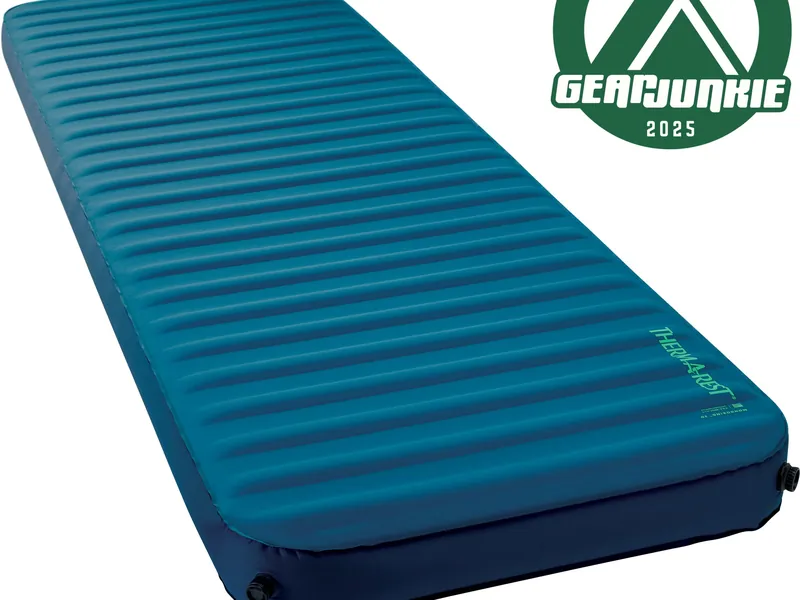
Therm-a-Rest MondoKing 3D
- Best for Solo car campers and side sleepers
- Strength Comfort plus warmth
- Tradeoff Solo width only
The MondoKing 3D is the cleanest solo recommendation because it gives car campers the two specs that matter most: real thickness and a strong warmth rating. It is more comfortable than narrow backpacking pads and still more packable than foam mattress systems.
Buy it if you camp alone, want one pad that works across most three-season conditions, and can tolerate a larger packed roll than an ultralight pad.
What works
- Thick support
- Good cold-weather margin
- Wide solo footprint
- Strong brand support
What to weigh
- Not for couples
- More expensive than basic pads
- Still puncturable
Skip if: You need a shared two-person sleep surface.
Best comfort-to-pack compromise
NEMO Roamer
- Best for Solo or double-pad buyers
- Strength Foam support in a packable roll
- Tradeoff Price and bulk
The Roamer is a strong car-camping pad for people who want more comfort than a backpacking pad but less bulk than a foam mattress. It sits in the sweet spot for SUVs, ground tents, and rooftop-tent toppers.
The double versions make sense for couples who want one shared surface. Solo buyers should compare packed size against the MondoKing before choosing.
What works
- Comfortable foam/air feel
- Useful single and double sizes
- Good for rooftop tent toppers
- Less bulky than foam systems
What to weigh
- Premium price
- Still needs careful storage
- Not as compact as air-only pads
Skip if: You need the smallest possible packed size.
Best couple-friendly pad
Sea to Summit Comfort Deluxe
- Best for Couples and basecamp setups
- Strength Broad size range
- Tradeoff Big packed roll
The Comfort Deluxe is a useful option when one shared sleep surface matters more than solo packability. It gives couples a more stable bed than two narrow pads sliding apart in the night.
The downside is the same as every comfort pad: it is not small. It belongs in a vehicle-camping kit, not a hiking pack.
What works
- Good double-pad option
- Stable shared surface
- Warm enough for common three-season use
- Comfort-first design
What to weigh
- Bulky
- Not cheap
- Less flexible than two separate pads
Skip if: You and your partner prefer different firmness levels.
Best backup and budget layer
NEMO Switchback
- Best for Backup warmth and puncture-proof layer
- Strength Cannot deflate
- Tradeoff Thin by itself
A closed-cell foam pad is not the most comfortable primary bed for vehicle camping, but it is one of the smartest backup layers. It adds warmth under an inflatable, protects from grit and dog claws, and still works if an air pad fails.
Use it under another pad in cold weather or as a cheap summer layer for short trips. Do not expect it to turn a hard cargo floor into a mattress by itself.
What works
- No puncture risk
- Cheap
- Adds stackable R-value
- Great emergency backup
What to weigh
- Thin comfort
- Bulky shape
- Not enough for many side sleepers
Skip if: You want one primary pad for multi-night comfort.
What goes wrong, according to owners
These are aggregated owner-report patterns from r/CampingGear threads, not failures we have observed ourselves. They recur often enough, with enough specific detail, to be worth planning around - but treat them as patterns rather than as failure rates.
- Valve failure is the top complaint on inflatables, and it is almost always the valve rather than the fabric. It also tends to appear after a season rather than out of the box, which is exactly the window a return policy does not cover. The mitigation is the foam pad underneath: a failed air pad on top of foam is an uncomfortable night, not a ruined trip.
- Crinkle noise on lightweight air pads with reflective internal films. It bothers some sleepers enormously and others not at all, and it does not appear on a spec sheet. Self-inflating foam-core pads are consistently reported as quieter, which is part of why they suit vehicle camping.
- Cold spots at the shoulder and hip - see the width section above. Owners frequently describe this as the pad being under-rated for warmth when the geometry is the actual cause.
- Slow leaks that only show up cold. Air contracts overnight as temperatures fall, so a pad can feel soft by 3 a.m. without leaking at all. Worth ruling out before returning a pad: top it up after it has cooled rather than inflating it hard at dusk.
Next step
Once the pad is chosen, finish the whole system: bedding, pillow, privacy, ventilation, and morning reset. The car camping sleep setup guide walks through that stack, and the rest of the sleep system covers the same ground for people sleeping inside the vehicle rather than beside it. For how we evaluate gear we have not slept on, read the methodology.
Frequently asked questions
What R-value sleeping pad do I need for car camping?
Is a backpacking sleeping pad good enough for car camping?
Should side sleepers buy a thicker pad?
Can I use a sleeping pad on top of a cot?
How we wrote this
A synthesis guide, not a hands-on review
This guide is a synthesis of manufacturer specifications, ASTM R-value guidance, independent reviews, and recurring owner reports. We have not personally tested every pad named here, so nothing on this page reports durability over time, valve reliability after a season, or real warmth against a rated R-value - those need nights slept per pad. What is original here is arithmetic you can check: shoulder width against pad width, and additive R-values against your forecast low. Affiliate links go to Amazon search results so prices stay current; we earn a commission when you buy, never at extra cost to you.
We have not field-tested every product mentioned. Where we describe a product we are synthesizing manufacturer specifications, independent expert reviews, and verified user feedback from forums. Sections will be replaced with first-hand notes once testing is complete. Read our full methodology.
References
Sources synthesized to write this guide. Manufacturer pages cite specifications; independent publications and forums cite real-world performance and failure patterns.
-
Industry standard for comparable sleeping-pad R-value testing.
-
Reference for pad types, R-values, and choosing by trip type.
-
Independent testing reference for comfort, packed size, and durability patterns.
-
Manufacturer source for MondoKing, NeoAir, and Z Lite specifications.
-
Manufacturer source for Roamer and Switchback specs.
-
Manufacturer source for double and single self-inflating comfort-pad specs.
-
Owner reports used to identify common complaints: narrow pads, noisy air pads, valve leaks, and under-rated warmth.