Disclosure: Some links on this page are affiliate links. Commissions never change our recommendations. Read the full disclosure.
Last updated
Reviewed May 18, 2026How we picked
A camping hammock has to clear four gates: it has to fit your sleeping style (back vs side vs stomach), survive a three-season trip in the rain, pack down small enough to live in a vehicle, and stay warm enough on shoulder-season nights. Most "best hammock" lists rank by price and weight. We rank by who actually sleeps well in each format.
That is why this guide has only four picks and three of them ship as full systems (or pair with one). A bare gathered-end hammock without a bug net, rain fly, and under-quilt is the cheapest way to be miserable in the woods. A complete system at any price tier is the cheapest way to sleep well.
| Product | Format | Weight rating | Best for | Price | Main tradeoff | Where to buy |
|---|---|---|---|---|---|---|
| | Gathered-end double | 400 lb | First hammock, casual basecamp use | $70-$85 | No bug net or rain fly included | Check price |
| | Full-system asymmetric | 250 lb | Three-season hammock-only campers | $210-$240 | Lay angle takes practice; rain fly is small for tall sleepers | See it at Hennessy Hammock |
| | Premium asymmetric | 400 lb | Back-sleepers and bigger campers who want a flat lay | $200-$240 | Highest price; long custom-build waitlists are common | See it at Warbonnet Outdoors |
| | Bridge / spreader-bar | 275 lb | Side-sleepers and ground-tent converts | $210-$260 | Heavier than gathered-end hammocks; the flat lay is the point | See it at Lawson Hammock |
Camping hammock picks compared
Best starter hammock
ENO DoubleNest
$70-$85
- Format
- Gathered-end double
- Weight rating
- 400 lb
- Best for
- First hammock, casual basecamp use
- Main tradeoff
- No bug net or rain fly included
Best complete three-season system
Hennessy Hammock Expedition Asym Zip
$210-$240
- Format
- Full-system asymmetric
- Weight rating
- 250 lb
- Best for
- Three-season hammock-only campers
- Main tradeoff
- Lay angle takes practice; rain fly is small for tall sleepers
Best premium hammock for back-sleepers
Warbonnet Blackbird XLC
$200-$240
- Format
- Premium asymmetric
- Weight rating
- 400 lb
- Best for
- Back-sleepers and bigger campers who want a flat lay
- Main tradeoff
- Highest price; long custom-build waitlists are common
Best bridge hammock for side-sleepers
Lawson Blue Ridge Camping Hammock Tent
$210-$260
- Format
- Bridge / spreader-bar
- Weight rating
- 275 lb
- Best for
- Side-sleepers and ground-tent converts
- Main tradeoff
- Heavier than gathered-end hammocks; the flat lay is the point
Top picks
Best starter hammock
ENO DoubleNest
- Best fit First hammock; warm-weather basecamp use
- Weight rating 400 lb
- Packed size About 4 x 5 in stuff sack
The ENO DoubleNest is the hammock most vehicle campers buy first because it sets up in 90 seconds, fits two people for lounging at camp, and costs less than dinner for four. The 70D ripstop nylon body is comfortable for back-sleepers up to about 6 ft 2 in once you learn the 30 degree strap-angle rule. Stuff sack attaches permanently so it never gets lost.
The reason it is not the only pick is what it does not include: no bug net, no rain fly, no straps. ENO sells those separately under the Atlas and ProFly names; budget another $60-100 for a working three-season setup. Buy it as a starter and an upgrade path, not a complete answer.
What works
- Cheapest credible camping hammock
- 400 lb capacity fits any solo or two-person lounging
- Stuff sack attached so it cannot get lost
- Widely available - usable warranty support
What to weigh
- Sold without straps, bug net, or rain fly
- Lay angle takes practice for back-sleep comfort
- 70D nylon stretches when wet and over multiple seasons
Skip if: You want a complete camping hammock system in one purchase or you sleep on your side.
Best complete three-season system
Hennessy Hammock Expedition Asym Zip
- Best fit Three-season hammock-only campers who want one purchase to cover everything
- Weight rating 250 lb
- Includes Hammock, integrated bug net, rain fly, tree straps, stuff sack
The Hennessy Expedition Asym Zip is the closest thing to a tent-in-a-bag in the hammock world. The asymmetric lay angles your body across the hammock instead of along it, which gives a much flatter sleep position for back-sleepers, and the integrated zip-on bug net makes the side-entry feel like a tent. The stock rain fly is small but works in three-season rain when pitched well.
Two caveats. The 250 lb weight rating is lower than the ENO, so larger campers should size up to the Hennessy Explorer Deluxe or compare with the Warbonnet Blackbird XLC. And the small stock fly is the first thing most owners replace with a bigger 11 x 11 ft diamond tarp once they decide they like hammock camping.
What works
- Single purchase covers hammock, bug net, fly, and straps
- Asymmetric lay sleeps flatter than parallel gathered-end
- Side-entry zip feels more like a tent than overhead hammock entries
- Hennessy 30-year track record in the hammock space
What to weigh
- 250 lb weight rating excludes some campers
- Stock rain fly is small for sideways rain or two-person stops
- Bottom-entry models require lifting yourself into the hammock - the Asym Zip variant solves this
Skip if: You weigh more than about 230 lb (where the safety margin tightens) or you want to start with the cheapest possible setup.
Hennessy Hammock does not sell through Amazon and we are not in their affiliate programme, so this is a plain link to the product page. We earn nothing if you buy it.
Best premium hammock for back-sleepers
Warbonnet Blackbird XLC
- Best fit Back-sleepers, bigger campers, anyone wanting the flattest gathered-end lay
- Weight rating 400 lb
- Includes Hammock with integrated bug net and shelf; rain fly and suspension sold separately
The Blackbird XLC is the hammock that hammock-camping veterans buy after they have decided this is how they sleep outside. The Warbonnet-designed asymmetric foot box pulls the foot end of the hammock laterally so your legs stay flat instead of pulling your shoulders up. The fabric shelf on the inside holds a headlamp, phone, and water bottle so you do not crawl out at 2 a.m.
Two real considerations. The Blackbird ships without a rain fly or straps - budget another $80-150 for a Mamajamba tarp and Cinch Buckle Straps. And the Warbonnet shop runs custom-build waitlists of 4-8 weeks, so the Amazon search route surfaces resellers; check shipping windows before clicking buy.
What works
- Flattest lay of any gathered-end hammock we considered
- 400 lb capacity covers any vehicle camper
- Built-in shelf for headlamp and water at night
- Made in Colorado with strong warranty support
What to weigh
- Hammock-only price; tarp and straps add $80-150
- Custom waitlist can be weeks long during summer
- Asymmetric lay requires learning the correct sleep diagonal
Skip if: You will only camp three or four nights a year - the comfort upgrade is real but the price-to-night does not pay off at low usage.
Warbonnet Outdoors does not sell through Amazon and we are not in their affiliate programme, so this is a plain link to the product page. We earn nothing if you buy it.
Best bridge hammock for side-sleepers
Lawson Blue Ridge Camping Hammock Tent
- Best fit Side-sleepers, hammock-curious ground-tent converts, hybrid use (hang or pitch on the ground)
- Weight rating 275 lb
- Includes Hammock with spreader bars, bug net, rain fly, tree straps, ground stakes
The Lawson Blue Ridge uses two short spreader bars at head and foot to keep the hammock body open like a cot, which gives a near-flat sleep surface that side-sleepers can actually use. It also pitches on the ground with the included stakes when there are no trees, which is the trick that earns it the hybrid-shelter label.
The honest tradeoff: it is heavier and bulkier than any gathered-end hammock here, and the spreader bars feel less cocoon-like at first. For back-sleepers who already enjoy hammocks, the Blackbird XLC is the better pick. For side-sleepers or anyone who has tried a gathered-end hammock and given up, the Blue Ridge is the hammock that converts them.
What works
- Near-flat sleep surface from spreader bars
- Pitches on the ground when trees are unavailable
- Complete system ships in one box
- Side-entry zip with full bug net
What to weigh
- Heavier than gathered-end hammocks
- 275 lb weight rating
- Spreader-bar packed length is longer than other hammocks here
Skip if: You are a confirmed back-sleeper who is happy in a gathered-end hammock - the bridge format trades cocoon comfort for flatness.
Lawson Hammock does not sell through Amazon and we are not in their affiliate programme, so this is a plain link to the product page. We earn nothing if you buy it.
The under-quilt problem most lists ignore
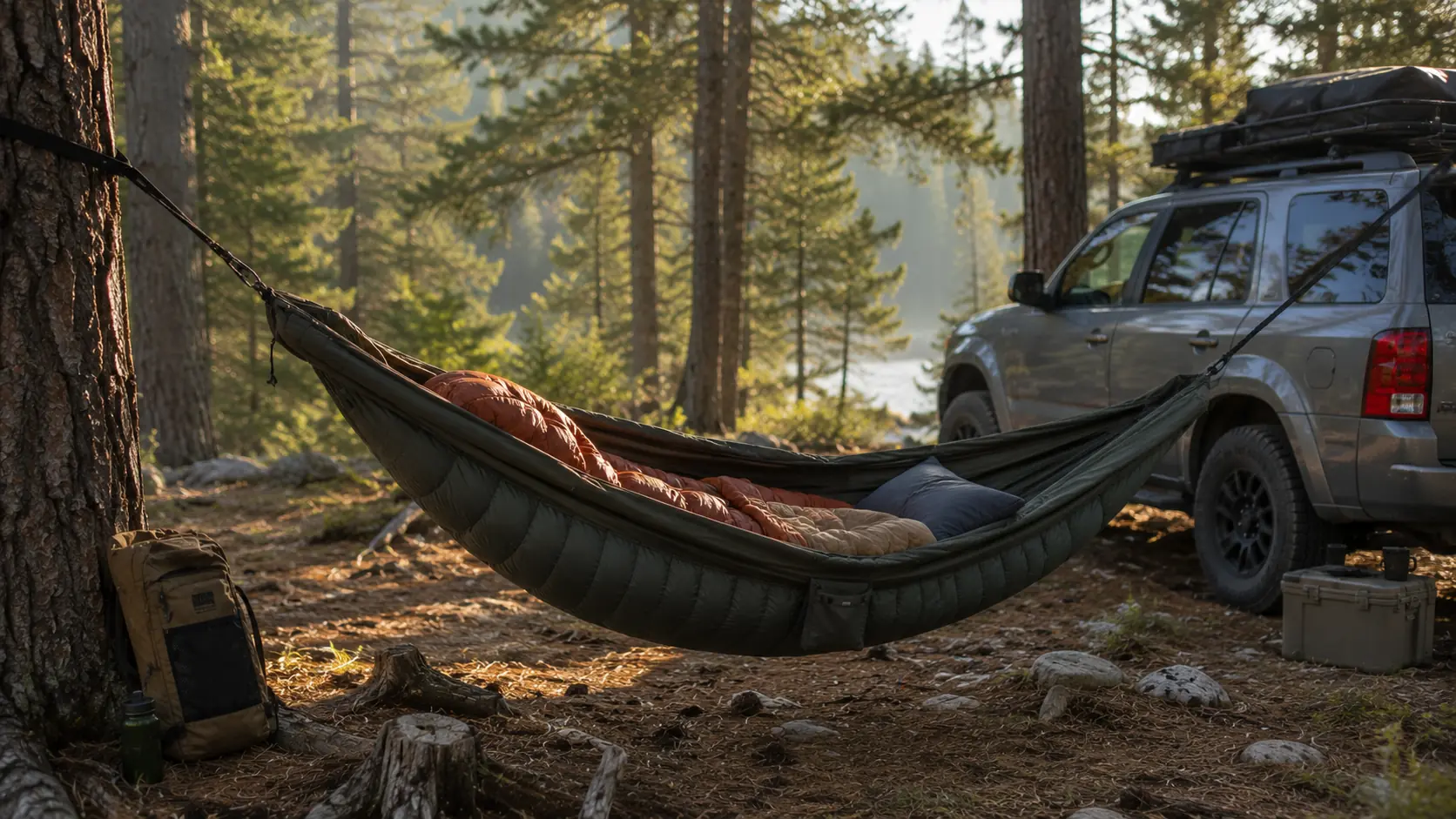
A hammock compresses any sleeping bag or pad placed underneath you to near-zero insulation. The compressed insulation cannot trap air, so the underside of your body sits against a thin layer of nylon hovering over open air. This is hammock camping's cold-butt syndrome, and it is the single most common reason new hammock campers say "never again" after a 50 F night.
Two fixes work. The cheaper one is a closed-cell foam pad slid into the hammock under your back - the ENO DoubleNest plus a Therm-a-Rest Z Lite pushes the comfort floor into the 50s F for most sleepers, though wind, humidity, and how cleanly the pad stays under you all move the number. The more comfortable fix is a synthetic or down under-quilt that hangs underneath the hammock; most owners eventually buy one. Hammock Gear, Warbonnet, and ENO all sell under-quilts in the $150-$400 range, and the comfort gain over a foam pad is large enough that long-trip hammockers treat the under-quilt as required gear, not an upgrade.
Tree straps, ridgelines, and the 30-degree rule
The single most useful technique you can learn for hammock camping is the 30 degree strap angle. Hung at 30 degrees from horizontal, a gathered-end hammock lays flatter, swings less, and puts less force on the trees and straps. Hung at 60 degrees (the rookie default - too low, too steep), the hammock cinches you into a banana shape and triples the force on the suspension points.
The 30 degree rule pairs with a fixed-length ridgeline. A non-stretch line tied between the two suspension points at about 83 percent of the hammock's total length forces the hammock to hang at the right angle every time. Most premium hammocks ship with one built in; for the ENO DoubleNest you add a Dynaglide ridgeline for about $15. It is the single cheapest comfort upgrade in this entire guide.
How the hammock fits in your sleep system
A hammock is one possible sleep surface, not a complete system. The bedding, insulation, and condensation-control decisions on the sleep hub still apply: an under-quilt is your sleeping pad, the rain fly is your shelter, and a 30 F sleeping bag still has to live on top of you. The car camping sleep setup guide covers how to swap a hammock layer into a complete system without buying twice.
For three-season rain protection, a 11 x 11 ft asymmetric or hexagonal tarp is the standard upgrade once the stock fly is no longer enough. A small camping fan helps with condensation under the tarp on still humid nights - the camping fan guide covers the rechargeable options that work for tent and hammock setups.
What to buy first
If this is your first hammock and you mostly camp in warm weather, buy the ENO DoubleNest plus a pair of dedicated tree straps and a closed-cell foam pad to slide under your back for shoulder-season trips. Total budget lands well under the cost of a single premium hammock, and the whole kit fits in a small stuff sack in any vehicle. If you already know you sleep better in a hammock than a tent, go straight to the Hennessy Expedition Asym Zip or the Warbonnet Blackbird XLC and skip the upgrade-path expense, then add an under-quilt rated for your coldest expected night - check the maker's own model lineup, since brands swap names and temp ratings between seasons.
The Lawson Blue Ridge is the right first hammock for anyone who has tried a gathered-end hammock and given up because they could not sleep. It is also the right hammock if your vehicle camping mixes campsites with trees and dispersed sites without them - you pitch it either way.
Frequently asked questions
Is a hammock comfortable for camping?
Do I need an under-quilt for a camping hammock?
How long should the tree straps be?
Can I sleep in a hammock when it rains?
Are hammocks safer than tents in bear country?
How we wrote this
A synthesis guide, not a hands-on review
This is a synthesis shortlist. We compare published specs, independent reviews, and recurring owner reports; we have not yet completed first-hand multi-night testing on every hammock listed. Affiliate links go to Amazon search results so prices stay current. We earn a commission when you buy, never at extra cost to you.
We have not field-tested every product mentioned. Where we describe a product we are synthesizing manufacturer specifications, independent expert reviews, and verified user feedback from forums. Sections will be replaced with first-hand notes once testing is complete. Read our full methodology.
References
Sources synthesized to write this guide. Manufacturer pages cite specifications; independent publications and forums cite real-world performance and failure patterns.
-
Manufacturer source for nylon weight, weight rating, and packed size on the most-recommended budget hammock.
-
Manufacturer source for the asymmetric lay, integrated bug net, and stock rain fly that anchor the full-system pick.
-
Manufacturer source for the asymmetric foot box, integrated shelf, and double-layer fabric in the premium pick.
-
Manufacturer source for the spreader-bar bridge shape that gives a near-flat lay for back- and side-sleepers.
-
Independent testing used for comfort, weight, and durability rankings across all four formats.
-
Independent editorial review covering casual, expedition, and bridge styles at multiple price tiers.
-
Owner-reported under-quilt requirements, cold-butt syndrome failure modes, and long-term durability signals.
-
Public reference on minimum 1 in wide tree straps to protect bark and avoid campsite bans.