Disclosure: Some links on this page are affiliate links. Commissions never change our recommendations. Read the full disclosure.
Last updated
Reviewed Aug 13, 2026Start here: are you cutting a hole in your roof?
Everything else follows from that one answer, and it is not really a question about airflow. It is a question about whether you own the vehicle, whether you keep it, and whether it has to look untouched on Monday.
- Yes, cutting a hole. A 12V roof fan is a different class of device: it exhausts air out of the vehicle rather than stirring it around, it runs all night on a trivial amount of power, and it is the only option here that genuinely fixes condensation. Budget $180-$400 plus half a day of install.
- No hole. You are choosing between a rechargeable fan (no infrastructure, one night of run time) and a mains fan run off a power station (more airflow, more draw, needs a station you probably already own). Budget $30-$150.
There is no in-between product worth recommending. Suction-cup window fans and battery clip-ons under about 8 inches do not move enough air to change how a closed cargo area feels, which is the most common reason people buy a second fan.
How we picked
A camping fan has to clear four gates: it has to mount where you actually sleep, run on a power source you actually carry, move enough air to matter (most "camping fans" are too small to do this), and stay quiet enough not to wake you up at 3 a.m.
That is why this guide does not rank every fan by CFM. A 1,500 CFM roof fan is wrong for a tent. A rechargeable USB fan is wrong for a van you sleep in 200 nights a year. The right format is the one whose constraints match how you camp.
What each fan costs you per night, in watt-hours
Fan reviews quote CFM and price. Neither tells you whether the fan will flatten your battery by 4 a.m. The figures below are the manufacturers' own published draw ranges, multiplied out over an eight-hour night. That is arithmetic, not testing - and it is the number that decides whether the fan and the power station you own can coexist.
| Fan | Published draw | 8 hr on low | 8 hr on high |
|---|---|---|---|
| MaxxAir MaxxFan Deluxe (12V) | 0.4-3.0 A at 12V (about 5-36 W) | ~40 Wh | ~288 Wh |
| Fan-Tastic Vent 7350 (12V) | 0.3-2.2 A at 12V (about 4-26 W) | ~29 Wh | ~211 Wh |
| Vornado 660 (120V AC) | 28-51 W continuous | ~224 Wh, or ~250-260 Wh drawn from the battery after inverter loss | ~408 Wh, or ~450-470 Wh after inverter loss |
| Geek Aire CF1 (built-in battery) | 15,600 mAh pack; pack voltage not published | Runs on its own battery, so it costs you nothing overnight - but the recharge cost cannot be calculated honestly, because milliamp-hours without a pack voltage do not convert to watt-hours. We are not going to guess the voltage to produce a tidier table. | |
Two conclusions fall straight out of that table. A 12V roof fan on low is essentially free - 40 Wh is less than a single phone-and-laptop charging session, and any station worth owning covers a week of it. And running a mains fan through an inverter is the most expensive way to move air, because you pay the conversion penalty on a load that runs all night. Add your fan to the nightly watt-hour budget to see it against the fridge, which is almost always the bigger term. The fridge and the fan draw from the same battery - fridge ventilation and the same battery budget covers the other half of that arithmetic. For how we handle numbers we have not measured ourselves, see how we evaluate gear we have not tested.
| Product | Mount | Power source | Best for | Price | Main tradeoff | Where to buy |
|---|---|---|---|---|---|---|
 | Roof cutout | 12V vehicle / house battery | Vans and hard-side truck campers | $329-$399 | Permanent install, roof cutout required | Check price |
 | Roof cutout | 12V vehicle / house battery | Budget van and camper builds | $179-$229 | Manual lid lift, no rain sensor | Check price |
 | Tabletop / floor | 120V AC (power station or shore power) | SUVs, ground tents, awning kitchens | $95-$120 | Needs an AC outlet or a large power station | Check price |
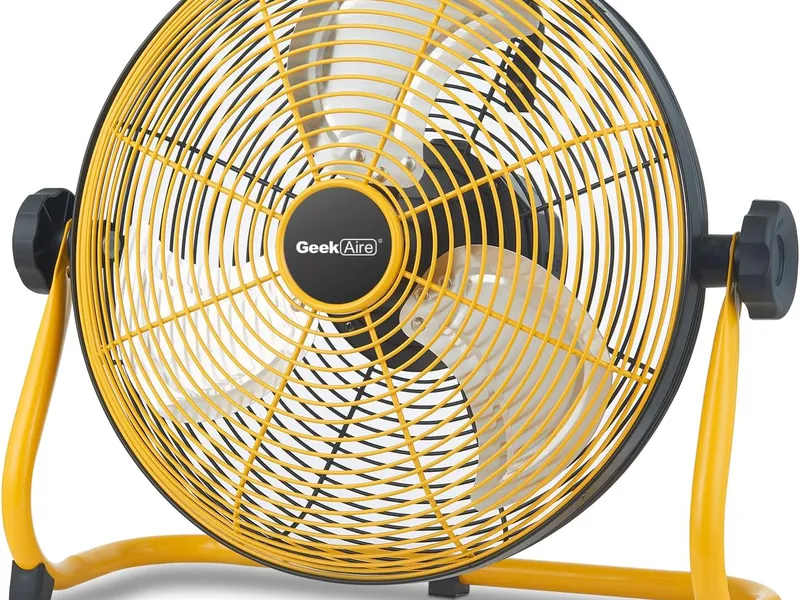 | Hanging / clip / floor | Built-in rechargeable battery | Ground tents and rooftop tents | $120-$150 | Battery life caps the overnight run | Check price |
Camping fan picks compared
Best roof fan for vans and campers
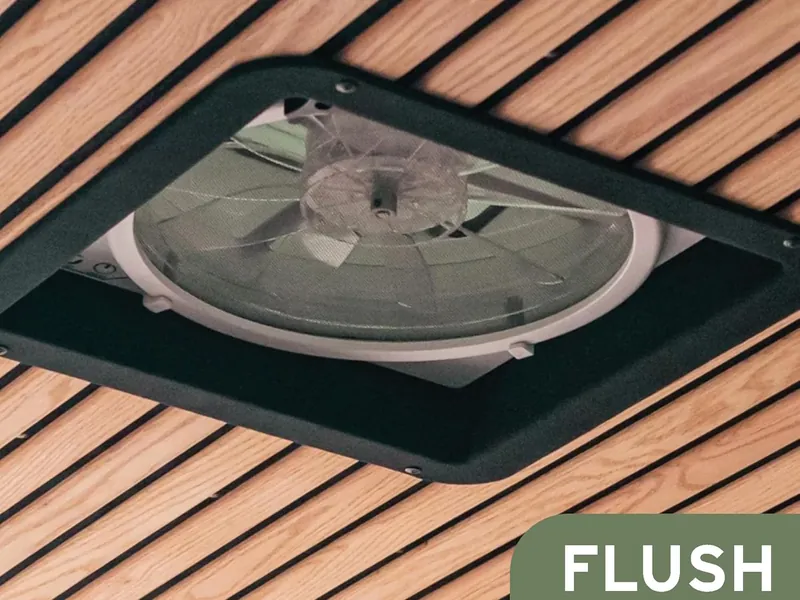
MaxxAir MaxxFan Deluxe
$329-$399
- Mount
- Roof cutout
- Power source
- 12V vehicle / house battery
- Best for
- Vans and hard-side truck campers
- Main tradeoff
- Permanent install, roof cutout required
Best budget roof fan
Fan-Tastic Vent 7350
$179-$229
- Mount
- Roof cutout
- Power source
- 12V vehicle / house battery
- Best for
- Budget van and camper builds
- Main tradeoff
- Manual lid lift, no rain sensor
Best AC vortex fan for awning kitchens
Vornado 660 Mid-Size Air Circulator
$95-$120
- Mount
- Tabletop / floor
- Power source
- 120V AC (power station or shore power)
- Best for
- SUVs, ground tents, awning kitchens
- Main tradeoff
- Needs an AC outlet or a large power station
Best rechargeable hanging fan
Geek Aire CF1 12 in Rechargeable
$120-$150
- Mount
- Hanging / clip / floor
- Power source
- Built-in rechargeable battery
- Best for
- Ground tents and rooftop tents
- Main tradeoff
- Battery life caps the overnight run
Top picks
Best roof fan for vans and campers
MaxxAir MaxxFan Deluxe
- Best fit Vans, hard-side truck campers, rooftop tents with shore power
- Power draw 0.4-3.0 A at 12V (5-36W)
- Install 14x14 in roof cutout
The MaxxFan Deluxe is the reference vehicle-camping fan because it does five things at once: rain-tolerant operation with the lid up, 10-speed reversible airflow, a thermostat, a wired remote, and a built-in rain sensor on the higher-tier model. It is the fan that owner threads quietly recommend on r/VanLife after someone burns out on a cheaper alternative.
The downside is the install. A 14x14 inch roof cutout is irreversible, you have to weatherproof the flange, and DC wiring to a house battery takes a half day. Once it is in, you forget it exists.
What works
- Rain-tolerant with lid up
- Reversible airflow (intake or exhaust)
- 10 speeds covers night-quiet to summer-dusk
- Wired remote and thermostat
What to weigh
- Permanent roof cutout
- Higher price than basic roof fans
- Some shipping units arrive with weatherstrip issues - inspect before install
Skip if: You do not own the vehicle or you cannot cut a 14x14 in opening in the roof.
Best budget roof fan
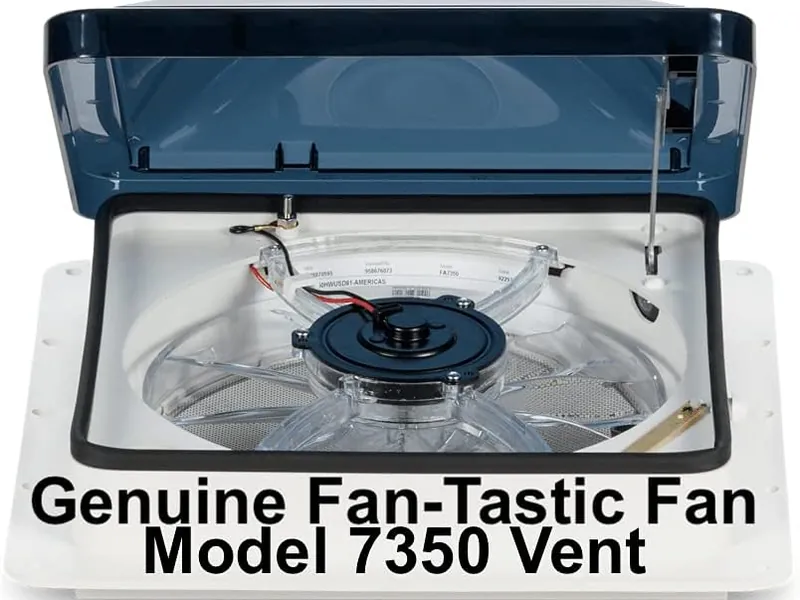
Fan-Tastic Vent 7350
- Best fit Budget van and truck-camper builds
- Power draw 0.3-2.2 A at 12V
- Install 14x14 in roof cutout
The Fan-Tastic Vent 7350 is the budget alternative to the MaxxFan that most pre-2020 van builds installed. It uses the same 14x14 inch cutout and moves enough air for a single-person van or a small truck camper. The omissions are real: no rain sensor, manual lid lift, and intake-only on the basic version.
It is the right pick when budget is the deciding factor. If you camp in rain often or want a reversible fan, the extra spend on the MaxxFan Deluxe pays for itself on the first storm.
What works
- Significantly cheaper than the MaxxFan Deluxe
- Same 14x14 cutout fits prior Fan-Tastic mounts
- Quiet on low speed
What to weigh
- No rain sensor
- Manual lid lift only
- Intake-only on the base model
Skip if: You camp in heavy rain regions or want reversible airflow from day one.
Best AC vortex fan for awning kitchens
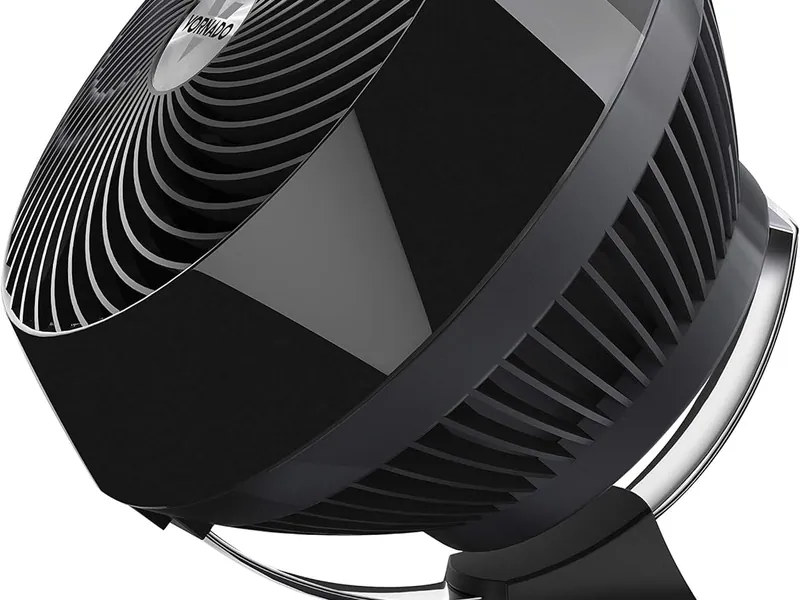
Vornado 660 Mid-Size Air Circulator
- Best fit SUVs and ground tents with a power station
- Power draw 28-51W continuous on 120V
- Footprint About 12 x 14 x 15 in - fits under most camp tables
The Vornado 660 is the easiest way to add real air movement to an SUV cargo area or a ground-tent setup that already has a power station. The 'vortex' airflow throws air across a small room rather than directly forward, which is closer to the experience of a ceiling fan than a cheap clip-on - moves air up to 100 ft per Vornado's own spec.
The constraint is that it needs a 120V outlet, so it only makes sense with a 500Wh+ power station or a shore-power site. On a small power bank, an inverter loss and 30-50W continuous draw will empty the battery in a few hours.
What works
- Strong airflow at low noise
- Multi-directional glide-bar tilt
- 4 speeds with detachable grille for cleaning
- 5-year warranty
What to weigh
- Needs AC outlet or 500Wh+ station with pure-sine inverter
- Larger than a clip-on or hanging fan
- No battery or DC mode
Skip if: You only camp without a power station or off-grid for multiple days.
Best rechargeable hanging fan
Geek Aire CF1 12 in Rechargeable
- Best fit Ground tents, rooftop tents, SUVs without a power station
- Battery 15,600 mAh built-in
- Run time About 24 hr at low, 5 hr at high
The Geek Aire CF1 is the easiest fan to add to a setup that does not have 12V wiring or a power station. The 12-inch blade actually moves usable air (most rechargeable fans do not), and the hook on the back lets it hang from a tent loop instead of taking floor space. It is louder than a roof fan at high but quiet enough on low to sleep through.
The downside is the standard rechargeable-fan downside: one night of run time at low, less at high. On a multi-day trip you need to recharge it from the vehicle or a power station between uses.
What works
- No install required
- Real airflow from a 12-inch blade
- Hanging hook keeps floor clear
- USB recharge
What to weigh
- Battery caps overnight run time
- Heavier than tiny clip-on fans
- Charge cycle eventually degrades the built-in battery
Skip if: You sleep in a permanent build that can support a 12V roof fan instead.
Cooling and condensation are two different jobs
Most fan guides treat these as one problem and they are not. Cooling is about moving air across your skin so sweat evaporates - a clip-on fan aimed at the bed does that perfectly well. Condensation is about moving humid air out of the vehicle and replacing it with drier air from outside. Stirring the same wet air faster does nothing for it.
That distinction changes what you should buy. If your complaint is heat, almost any fan pointed at you works, and the cheapest rechargeable is a rational purchase. If your complaint is waking up to water running down the inside of the windows, you need air exchange: a roof fan set to exhaust, or a portable fan positioned to push air out of one cracked window while another cracked window on the opposite side lets fresh air in. Aim matters more than airflow rating.
Why it is worth solving: two adults breathing inside a closed vehicle for eight hours put roughly half a litre of water into the air. It condenses on the coldest surface, which is the glass, and then runs down into the mattress. By morning the bedding is damp; by the third night it has stopped drying out between uses. This is the failure mode that ends trips early, and it is more common than being cold.
Worth saying plainly, because it costs us a sale: cracking two windows on opposite sides of the vehicle moves more air than a clip-on fan does, and it costs nothing. Try that before buying anything. A fan earns its place when the night is still, when the windows have to stay nearly shut for weather or insects, or when you want the air moving without the noise from outside coming in with it.
Power planning for fans
A roof fan draws 5-36W depending on speed; an AC tower fan draws 30-60W. A multi-day trip with a 12V roof fan running overnight every night is only sustainable if the vehicle is charging the house battery during the day or a power station is in the mix. The full sizing math lives in the power station sizing calculator, and the matching station picks are in the best portable power station guide.
What to buy first
If you do not already have a fan, buy the Geek Aire CF1 or a similar 12-inch rechargeable. That single purchase fixes condensation on most nights and works in every shelter format - tent, SUV, truck topper, and rooftop tent. Once you know how often you camp in closed shells, the upgrade to a MaxxFan Deluxe is the second-biggest comfort jump available in this entire hub.
Ventilation is also the cheapest hedge against the moisture that cooking inside a closed vehicle generates - the camping stove guide flags why you should never cook with a combustion stove inside a sealed cargo area, and a fan is the simplest mitigation when you do cook in sheltered conditions. Truck-topper owners get the biggest comfort jump of any group from a roof fan; the truck camper shell guide covers which shells are rated for one. If you camp under an awning, a portable fan keeps the kitchen and seating area livable in summer - see the vehicle awning guide for the shade side of the same problem.
Frequently asked questions
What is the best fan for camping in a tent?
Are roof fans worth it in a van or truck camper?
How much battery does a 12V fan draw?
Do I need a fan if I sleep in an SUV with the windows open?
Can I use a household fan when camping?
How we wrote this
A synthesis guide, not a hands-on review
This is a synthesis shortlist. We have not run any of these fans overnight, so this page publishes no measured decibel figure, no measured CFM, and no verified run-time - those need a sound meter and a logged night per fan, and we say so rather than repeating a marketing number as if we had checked it. What is original here is arithmetic: the watt-hours-per-night table is calculated from each manufacturer's own published power draw, so you can size the fan and the battery together. Noise and airflow rankings are attributed to OutdoorGearLab's testing, and failure modes are aggregated owner-report patterns, labelled as such.
We have not field-tested every product mentioned. Where we describe a product we are synthesizing manufacturer specifications, independent expert reviews, and verified user feedback from forums. Sections will be replaced with first-hand notes once testing is complete. Read our full methodology.
References
Sources synthesized to write this guide. Manufacturer pages cite specifications; independent publications and forums cite real-world performance and failure patterns.
-
Manufacturer source for airflow, power draw, and rain-tolerant operation specs.
-
Manufacturer source for the budget roof-fan alternative in van and truck-camper builds.
-
Manufacturer source for portable AC vortex fan output, noise, and footprint.
-
Manufacturer source for rechargeable battery fan capacity and run-time figures.
-
Independent testing used for noise and airflow signals at multiple speed settings.
-
Owner-reported MaxxFan vs Fan-Tastic comparisons and rechargeable-fan failure modes used for failure-mode framing.
-
Public-health reference for why ventilation matters in any sealed sleeping space.