Disclosure: Some links on this page are affiliate links. Commissions never change our recommendations. Read the full disclosure.
Last updated
Reviewed May 18, 2026How we picked
A vehicle awning has to clear four gates: it has to deploy fast enough that you actually use it on a one-night stop, it has to give meaningful shade for the kitchen and camp chair area, it has to tolerate the wind you typically camp in, and it has to mount to a rack rated for the dynamic load it adds. The right awning is the one whose constraints match how you camp.
That is why this guide does not rank every awning by coverage square footage. A 270-degree wraparound is wrong for a one-night stop because you will not deploy it. A side-pull 2m is wrong for a five-night basecamp because half your camp is in the sun half the day. The right format follows from your trip pattern.
| Product | Format | Coverage | Best for | Price | Main tradeoff | Where to buy |
|---|---|---|---|---|---|---|
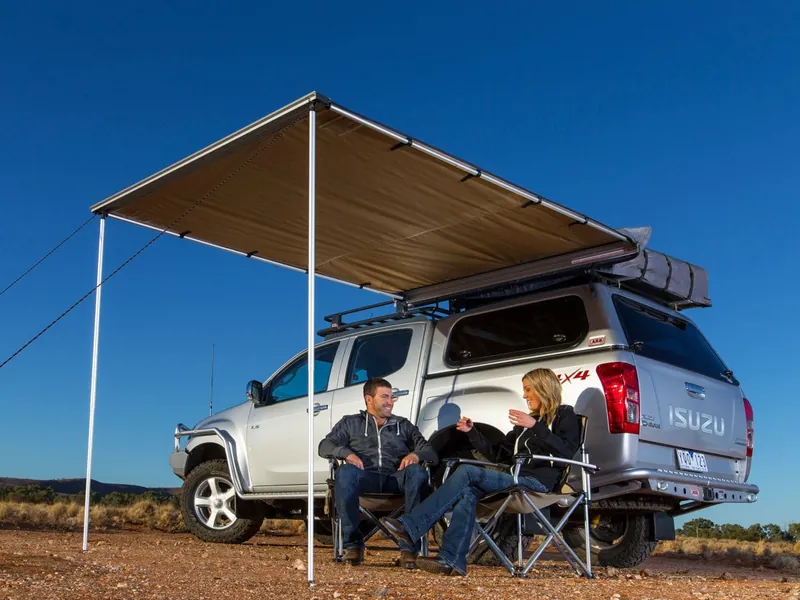 | Side-pull awning | 6.5 ft x 8 ft | Safe default for SUVs and trucks | $280-$340 | Single-side coverage only | Check price |
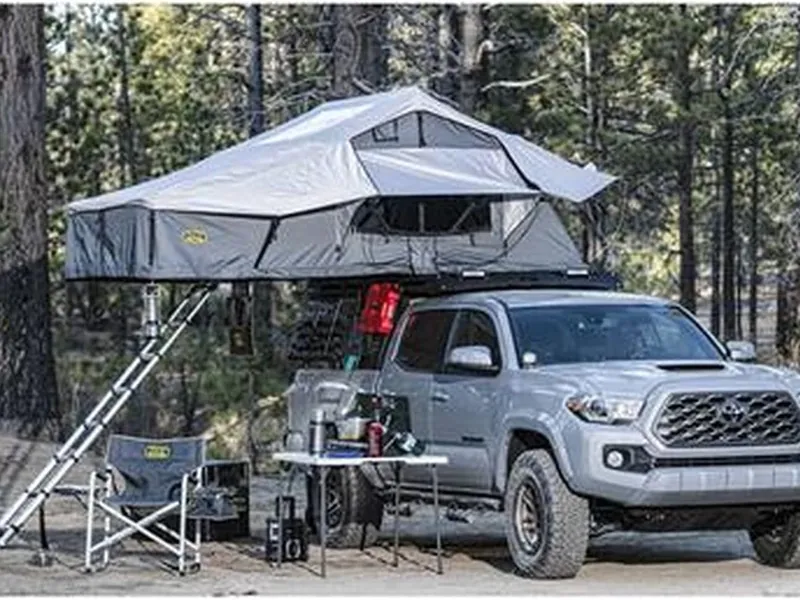 | Side-pull awning (budget) | 8 ft x 6.5 ft | Lowest credible price tier | $170-$220 | Fabric and seams thinner than ARB | Check price |
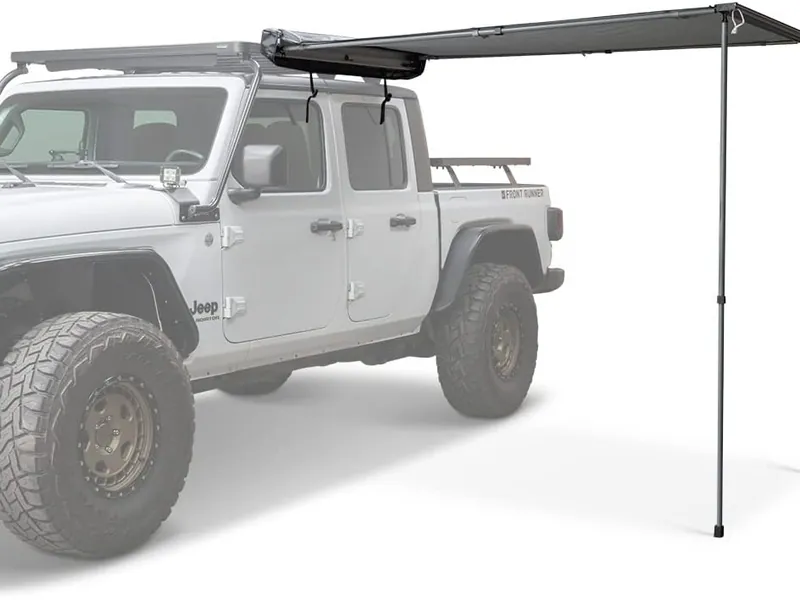 | Side-pull awning (rack-integrated) | 8 ft x 7 ft | Slimline II / LockNLoad rack owners | $330-$390 | Best with a Front Runner rack | Check price |
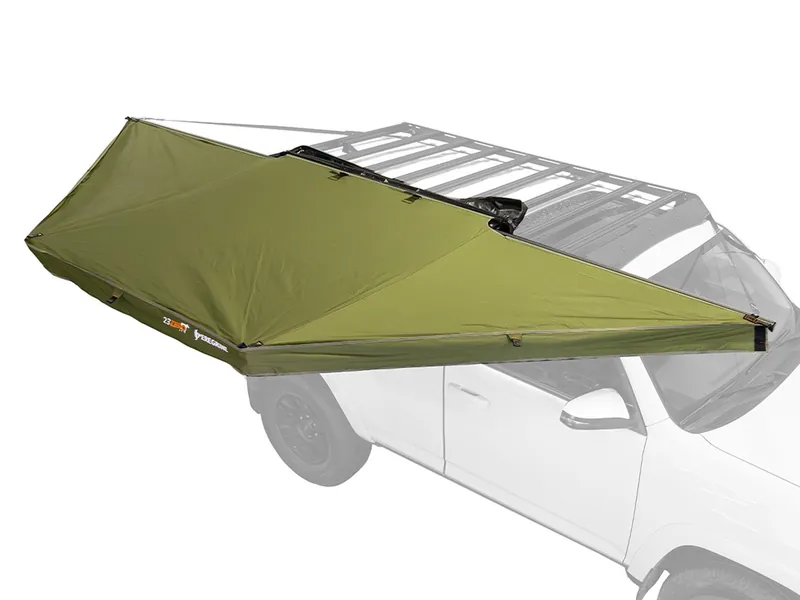 | Bat-wing awning | Wraparound 180-degree | Basecamp stays of 2+ nights | $520-$680 | Slower to deploy than a side-pull | Check price |
| | 270-degree wraparound awning | 270-degree wraparound | Long-stay basecamp builds | $1,400-$1,800 | Heaviest and most expensive | Check price |
Vehicle awning picks compared
Best side-pull awning
ARB 2000 Awning (2m)
$280-$340
- Format
- Side-pull awning
- Coverage
- 6.5 ft x 8 ft
- Best for
- Safe default for SUVs and trucks
- Main tradeoff
- Single-side coverage only
Best budget side-pull awning
Smittybilt GEN2 2.5m Awning
$170-$220
- Format
- Side-pull awning (budget)
- Coverage
- 8 ft x 6.5 ft
- Best for
- Lowest credible price tier
- Main tradeoff
- Fabric and seams thinner than ARB
Best awning for Front Runner rack owners
Front Runner Easy-Out 2.5m
$330-$390
- Format
- Side-pull awning (rack-integrated)
- Coverage
- 8 ft x 7 ft
- Best for
- Slimline II / LockNLoad rack owners
- Main tradeoff
- Best with a Front Runner rack
Best bat-wing awning for basecamp
23Zero Peregrine 180 Bat-Wing
$520-$680
- Format
- Bat-wing awning
- Coverage
- Wraparound 180-degree
- Best for
- Basecamp stays of 2+ nights
- Main tradeoff
- Slower to deploy than a side-pull
Best 270-degree wraparound awning
ARB Touring II 270-Degree Awning
$1,400-$1,800
- Format
- 270-degree wraparound awning
- Coverage
- 270-degree wraparound
- Best for
- Long-stay basecamp builds
- Main tradeoff
- Heaviest and most expensive
Top picks
Best side-pull awning
ARB 2000 Awning (2m)
- Best fit SUVs, mid-size trucks, daily-driver vehicles
- Coverage 6.5 ft x 8 ft when deployed
- Weight About 24 lb
The ARB 2000 is the reference side-pull awning because of heavy ripstop fabric, a fully waterproof seam construction, an integrated PVC bag that keeps red dirt off the fabric, and an Australian outback durability track record that goes back two decades. It is the awning that gets quietly recommended in r/Overlanding and ExpeditionPortal when someone burns out on a cheaper alternative.
The 2m (2000mm) size is the right starting size for most SUVs and mid-size trucks. The longer 2.5m version is appropriate for full-size SUVs and trucks; the shorter 1.4m version is fine for compact crossovers but coverage suffers.
What works
- Heavy ripstop fabric survives years of UV
- Integrated PVC bag keeps the fabric clean in transit
- Fully waterproof seams
- Wide ARB dealer network for warranty issues
What to weigh
- Single-side coverage only
- Slightly heavier than budget side-pulls
- Premium price vs Smittybilt GEN2
Skip if: You stay multiple nights at one site and need wraparound shade.
Best budget side-pull awning
Smittybilt GEN2 2.5m Awning
- Best fit Budget overlanding builds
- Coverage 8 ft x 6.5 ft when deployed
- Weight About 30 lb
The Smittybilt GEN2 is the value benchmark in this category. The fabric is noticeably lighter than the ARB 2000 (Smittybilt publishes 600D polyester; ARB uses a heavier ripstop), the seams are slightly less waterproof, and the bag is nylon rather than ARB's PVC - but the deploy-and-go function works the same. The GEN2 is one of the most-recommended awnings in r/Overlanding for first-time budget builds.
Owners on the long-term threads commonly report the lighter Smittybilt fabric fading and weakening faster than the ARB 2000 in heavy-sun climates, especially the desert Southwest. Inspect stitching annually and treat budget fabric as a roughly half-life version of the premium ones rather than a permanent install.
What works
- Roughly half the price of ARB 2000
- Wider 2.5m coverage at the price
- Easy to find used in good condition
- Same install pattern as ARB / Front Runner
What to weigh
- Lighter fabric is less UV-durable
- Nylon bag picks up dirt and tears
- Some seams need re-sealing earlier than ARB
Skip if: You camp in desert or coastal climates where UV and salt accelerate fabric failure.
Best awning for Front Runner rack owners
Front Runner Easy-Out 2.5m
- Best fit Front Runner Slimline II or Yakima LockNLoad rack
- Coverage 8 ft x 7 ft when deployed
- Weight About 22 lb
The Front Runner Easy-Out is the natural awning choice for builds that already run a Front Runner Slimline II rack. The L-brackets bolt directly into Slimline II slots, the awning sits closer to the rack profile (less wind noise), and Front Runner's fabric quality sits between ARB and Smittybilt.
On a non-Front-Runner rack it costs more than the ARB 2000 without a clear functional advantage; the value calculation only works if you already own or want a Slimline II.
What works
- Cleanest integration with Front Runner racks
- Lighter than ARB and Smittybilt
- Lower wind noise than aftermarket mounts
What to weigh
- More expensive than ARB on most racks
- Best with a Front Runner rack - awkward on Thule / Yakima factory bars
- Smaller dealer network than ARB
Skip if: You do not run a Front Runner or Yakima LockNLoad rack.
Best bat-wing awning for basecamp
23Zero Peregrine 180 Bat-Wing
- Best fit Basecamp stays of 2+ nights
- Coverage 180-degree wraparound, ~9 ft radius
- Weight About 42 lb
The 23Zero Peregrine bat-wing is the cost-effective alternative to ARB's Touring II 270-degree awning. The wing covers the rear quarter and rear face of the vehicle, which is enough for kitchen plus seating area in one shaded zone. It is significantly faster to deploy than a 270-degree but slower than a side-pull.
Bat-wings are not first-time-buyer awnings. The deploy choreography (4-5 support poles, longer guy lines) is best learned over a few trips. For campers who already own a side-pull and stay at the same site repeatedly, the upgrade is worth it.
What works
- Wraparound shade without the cost of 270 degrees
- Reasonable price for the coverage class
- Holds wind well with all support poles tensioned
What to weigh
- Heavier than a side-pull (42 lb vs 24 lb)
- Deploy is slower and benefits from two people
- Acts as a sail in 25+ mph wind
Skip if: You move camp every night - the deploy is too slow to be worth it on one-night stops.
Best 270-degree wraparound awning
ARB Touring II 270-Degree Awning
- Best fit Long-stay basecamp and overlanding builds
- Coverage 270-degree wraparound, ~9 ft radius
- Weight About 60 lb
The ARB Touring II is the premium 270-degree awning and the format ceiling. It covers from the front of the rear passenger door, around the back of the vehicle, to roughly the front of the driver passenger door - essentially all three exposed sides. It is the awning you buy when you stay multiple nights, cook outside the vehicle, and want shade or rain cover regardless of sun direction.
This is not a casual purchase. It is heavy enough to require careful rack-load planning, expensive enough to be a real budget decision, and slow enough to deploy that it is wrong for one-night road trips. For long basecamp users, it is the format leader.
What works
- Truly wraparound shade
- Built to ARB's flagship durability standard
- Holds tension well in moderate wind
- Optional walls extend it into a partial room
What to weigh
- Heavy (60 lb)
- Most expensive awning here
- Slow to deploy (3-5 minutes solo)
- Eats significant rack load capacity
Skip if: Your trips average less than two nights at the same site.
Wind and mount: the two specs that decide failure mode
Awning failure almost always happens in wind. The two factors that decide whether it survives are surface area (a side-pull is more wind-tolerant than a 270-degree because the wraparound section acts as a sail) and how well the support legs and guy lines are tensioned. Owner reports in r/Overlanding consistently show that brand matters less than setup discipline - a guyed-out Smittybilt GEN2 outlasts a lazily-set ARB Touring II in the same gust.
Mount load matters because a deployed awning is a long lever - the gust force on the fabric pulls on the crossbars far harder than the static weight of the awning alone, and that load scales fast as wind rises. Factory crossbars are usually fine for a 2m side-pull at low wind, but a 270-degree on factory bars is at the edge of safe load and starts to feel sketchy in gusts. If you plan to run a wraparound, the matching rack (Front Runner Slimline II, Prinsu, Yakima LockNLoad) is part of the budget.
Once the awning is settled
An awning earns its keep when the rest of the camp is set up under it. Pair it with a real seating setup so you actually sit at camp (we cover chairs and storage layouts on the vehicle accessories hub), a fast two-burner camp stove so the kitchen lives under the shade, and a portable camp fan if you camp in heat. Truck-bed builds get the most out of a side-pull awning deployed off the bed rails; the truck camper shell guide covers shells with awning-compatible rails. The recovery boards can wait.
Frequently asked questions
What is the best vehicle awning for camping?
How long does a vehicle awning take to deploy?
Do vehicle awnings hold up in wind?
Can I sleep under a vehicle awning?
Do I need a roof rack for a vehicle awning?
How we wrote this
A synthesis guide, not a hands-on review
This is a synthesis shortlist. We compare manufacturer specs, independent reviews, and recurring owner reports; we have not yet completed first-hand multi-month installs on every awning listed. Affiliate links go to Amazon search results where available. Front Runner and ARB Touring II are primarily dealer-fit; manufacturer links are provided for those.
We have not field-tested every product mentioned. Where we describe a product we are synthesizing manufacturer specifications, independent expert reviews, and verified user feedback from forums. Sections will be replaced with first-hand notes once testing is complete. Read our full methodology.
References
Sources synthesized to write this guide. Manufacturer pages cite specifications; independent publications and forums cite real-world performance and failure patterns.
-
Manufacturer source for fabric weight, mounting, and coverage area.
-
Manufacturer source for the 270-degree awning used as the long-stay upgrade pick.
-
Manufacturer source for the budget side-pull awning benchmark.
-
Manufacturer source for the Easy-Out 2.5m awning used by Slimline II rack owners.
-
Manufacturer source for the 180-degree bat-wing awning as the basecamp-stay format.
-
Long-running overland publication used for ARB / Smittybilt / 23Zero durability context.
-
Owner-reported wind-failure modes and deploy-time comparisons across brands.