Disclosure: Some links on this page are affiliate links. Commissions never change our recommendations. Read the full disclosure.
Last updated
Reviewed Aug 13, 2026This page covers shells and toppers - the roof you put over an existing truck bed, from a $1,800 fibreglass cap to a $17,000 pop-up. If you are looking at a self-contained camper that slides into the bed with a wet bath, a galley, and water tanks, that is a different purchase with different payload consequences: compare slide-in truck bed campers instead .
How we picked
A truck camper shell has to clear four gates for camping use: real window ventilation (sliding side windows with screens, not fixed glass), quality seals that survive years of vibration, a roof load rating that supports the rack or fan you actually want to install, and a bed-rail mount that does not chew through the truck's bed sheet metal.
Most topper roundups skip all four because they treat toppers as cargo accessories rather than sleep platforms. Every property below is filtered through whether the shell works as a place to sleep, not as a place to keep tools dry.
Do the payload subtraction first
More people are disqualified by this number than by any spec on a shell's page, and almost nobody checks it before shopping. Your truck's payload is printed on a yellow sticker inside the driver's door jamb, on a line that reads "the combined weight of occupants and cargo should never exceed X lbs." That figure is specific to your truck as it was built - trim, cab, drivetrain, and options all move it, so a generic figure from a brochure is not good enough.
Everything you add comes out of that one number, including the people in the seats. Here is the subtraction with a 1,500 lb sticker, which is a common figure for a mid-size crew cab:
- 1,500 lb payload on the door sticker
- − 2 adults at 180 lb = 360 lb → 1,140 lb left
- − pop-up shell at 275 lb → 865 lb left
- − bed platform and mattress, ~120 lb → 745 lb left
- − fridge, power station, and recovery gear, ~150 lb → 595 lb left
- − water at 8.34 lb per US gallon; 15 gallons = 125 lb → 470 lb left
- − a full bed rack and awning, ~120 lb → 350 lb left
Still legal, with room for food, clothing, and a dog. Run the same subtraction with a 480 lb premium pop-up and a 1,100 lb sticker and you finish under 100 lb, which is where people quietly start driving overloaded.
Two things this arithmetic makes obvious. A fibreglass topper at roughly 140-165 lb costs a fifth of what a premium pop-up costs in payload, which is a real argument for the cheaper product rather than a consolation. And water is heavier than people expect: 8.34 lb per US gallon means a 20 gallon tank weighs more than a topper.
| Product | Format | Approx weight | Best for | Price | Main tradeoff | Where to buy |
|---|---|---|---|---|---|---|
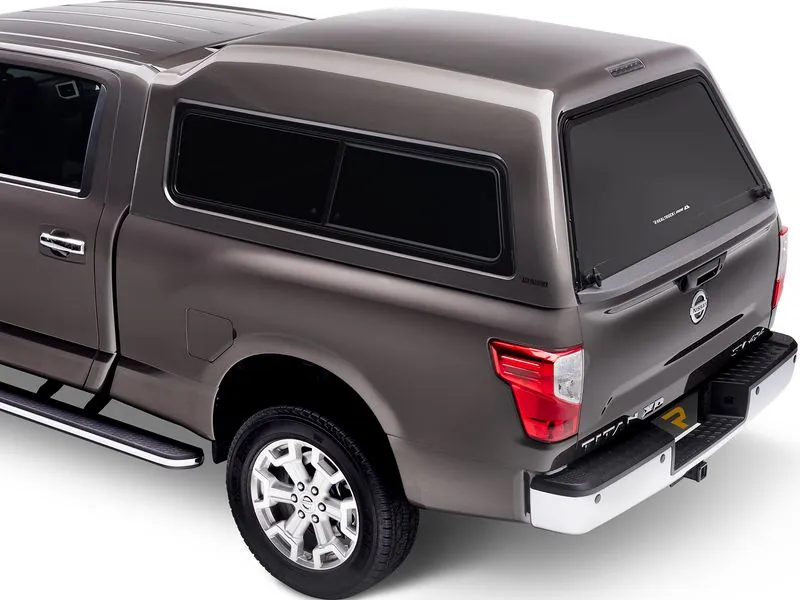 | Painted fiberglass topper | About 150 lb | Weekend dual-use truck | $2,200-$3,500 installed | No standing room, no insulation | See it at A.R.E. |
| | Painted fiberglass topper (budget) | About 140 lb | Lowest-cost credible camping topper | $1,800-$2,800 installed | Fewer window upgrades than A.R.E. | See it at Leer |
| | Sport-style fiberglass topper | About 165 lb | Stealth and modern profile | $3,000-$4,500 installed | Higher base price for sport styling | See it at SnugTop |
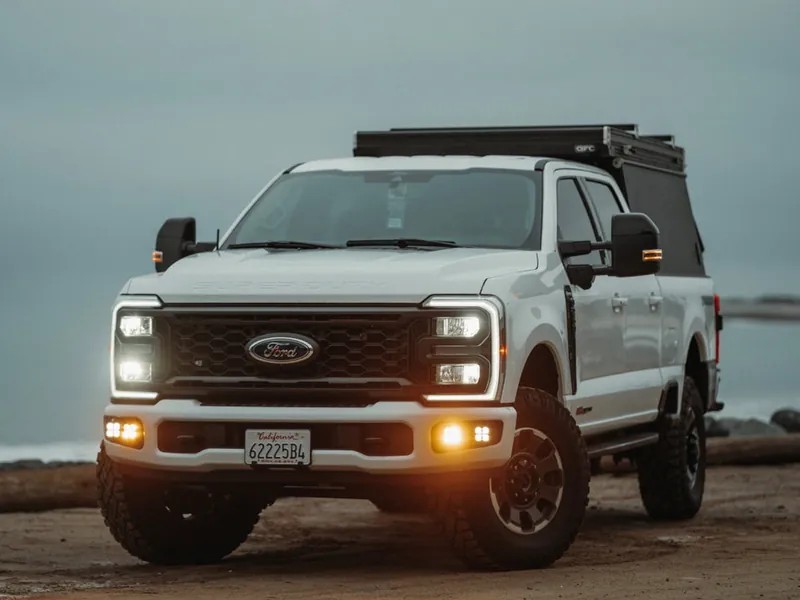 | Aluminum pop-up shell with tent | About 275 lb | Overlanders who sleep up top | $7,950 base | Semi-permanent install; you sleep above the bed, not in it | See it at Go Fast Campers |
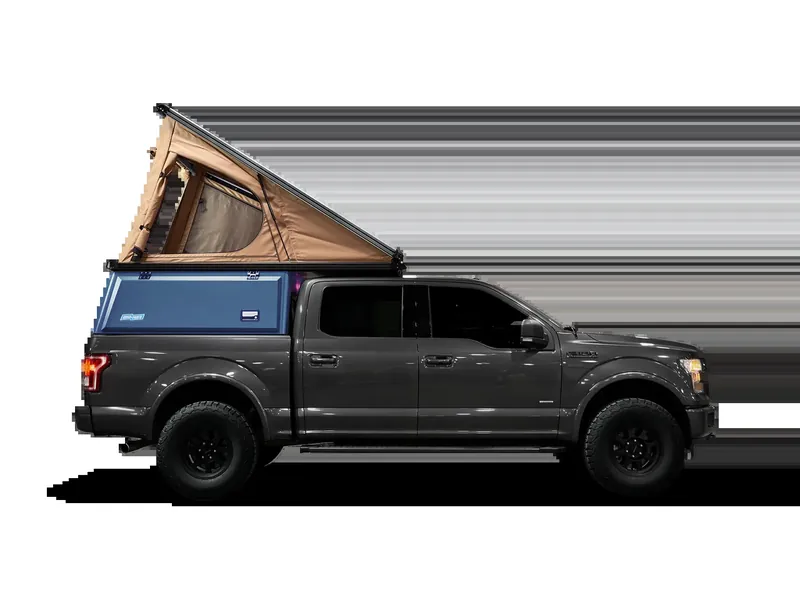 | Aluminum pop-up shell with tent | About 480 lb | Higher-end pop-up shell builds | $13,000-$17,000 | Significantly heavier and pricier than GFC | See it at Super Pacific |
Truck camper shell picks compared
Best topper for camping use
A.R.E. MX Series
$2,200-$3,500 installed
- Format
- Painted fiberglass topper
- Approx weight
- About 150 lb
- Best for
- Weekend dual-use truck
- Main tradeoff
- No standing room, no insulation
Best budget painted topper
Leer 100R
$1,800-$2,800 installed
- Format
- Painted fiberglass topper (budget)
- Approx weight
- About 140 lb
- Best for
- Lowest-cost credible camping topper
- Main tradeoff
- Fewer window upgrades than A.R.E.
Best topper for stealth and modern profile
SnugTop Rebel
$3,000-$4,500 installed
- Format
- Sport-style fiberglass topper
- Approx weight
- About 165 lb
- Best for
- Stealth and modern profile
- Main tradeoff
- Higher base price for sport styling
Best entry pop-up shell
Go Fast Campers V2 Pro Camper
$7,950 base
- Format
- Aluminum pop-up shell with tent
- Approx weight
- About 275 lb
- Best for
- Overlanders who sleep up top
- Main tradeoff
- Semi-permanent install; you sleep above the bed, not in it
Best premium pop-up shell
Super Pacific X1
$13,000-$17,000
- Format
- Aluminum pop-up shell with tent
- Approx weight
- About 480 lb
- Best for
- Higher-end pop-up shell builds
- Main tradeoff
- Significantly heavier and pricier than GFC
Top picks
Best topper for camping use
A.R.E. MX Series
- Best fit Weekend dual-use truck
- Weight About 150 lb
- Roof load Rated for rack accessories and a small fan
The A.R.E. MX Series is the reference camping topper because it combines full T-slot tracks on the roof, sliding side windows with screens, a rear glass with a rotary handle, and color-matched paint that holds up. It is the topper that owner threads quietly recommend after upgrading from a cheaper one.
Pair it with a 4 inch foam mattress on a $200 folding platform and you have a credible weekend camping setup for $3,000 to $4,000 total. That is the cheapest credible truck-bed camping setup that does not feel like a compromise.
What works
- Full T-slot tracks for rack accessories
- Sliding side windows with screens
- Real rear glass with rotary latch
- Strong color-matched paint, fits dealer install
What to weigh
- No standing room
- No insulation - condensation manageable only with cracked windows
- Dealer-installed - no DIY discount path
Skip if: You want indoor standing room or year-round insulated sleeping.
A.R.E. does not sell through Amazon and we are not in their affiliate programme, so this is a plain link to the product page. We earn nothing if you buy it.
Best budget painted topper
Leer 100R
- Best fit Lowest-cost credible camping topper
- Weight About 140 lb
- Roof load Lower than A.R.E. MX without optional crossbars
The Leer 100R is the value benchmark for painted fiberglass toppers. It is the most common topper at suburban truck-cap dealerships and the one most people compare everything else against. It has sliding side windows on most configurations and a usable rear glass.
The omissions vs the A.R.E. MX are real but minor for most users: fewer pre-drilled T-slots, fewer window-style options, and slightly more variability in paint match across dealers. If budget is the deciding factor, this is the topper to start with.
What works
- Cheapest painted topper that does not feel like a compromise
- Widely available used
- Sliding side windows with screens on most configurations
What to weigh
- Fewer roof-rack mount options than A.R.E. MX
- Color match varies dealer to dealer
- Add-on accessories often cost more than on competitors
Skip if: You want a roof rack from day one and the A.R.E. MX is in budget.
Leer does not sell through Amazon and we are not in their affiliate programme, so this is a plain link to the product page. We earn nothing if you buy it.
Best topper for stealth and modern profile
SnugTop Rebel
- Best fit Stealth city parking and modern profile
- Weight About 165 lb
- Roof load Strong - SnugTop rails available
The SnugTop Rebel is the topper that looks like it belongs on a truck instead of being added to it. The sport-style sloped rear gives a modern profile, the side windows are flush, and the optional SnugTop rails accept a fan or solar panel without aftermarket adapters.
It costs more than equivalently sized A.R.E. or Leer toppers, mostly for the styling. The camping function is comparable; the value calculation depends on how much the design matters to you.
What works
- Modern sloped profile reads as factory
- Flush windows look cleaner than slider styles
- SnugTop rails accept rack/fan/solar
What to weigh
- Higher base price than A.R.E. MX and Leer 100R
- Sloped rear can reduce usable cargo height at the tailgate
- Dealer network smaller than Leer's
Skip if: Modern styling is not worth the price premium over an A.R.E. MX.
SnugTop does not sell through Amazon and we are not in their affiliate programme, so this is a plain link to the product page. We earn nothing if you buy it.
Best entry pop-up shell
Go Fast Campers V2 Pro Camper
- Best fit Active overlanders, queen sleep on top
- Weight About 275 lb
- Sleeps 2 adults + kid or dog on the platform
The Go Fast Campers V2 Pro Camper (the truck-shell-plus-pop-up product, not to be confused with their SuperLite rooftop tent) is the easiest entry to the pop-up shell category because the base price sits below most competitors, the weight stays well inside mid-size truck payload, and the company has a dense waitlist that signals the resale value is healthy. The aluminum shell leaves the bed open at the tailgate while sleeping two adults on the platform on top.
It is semi-permanent. GFC builds each unit to a specific truck make and model and the install is partner-shop or HQ - removing one for daily use takes hours, not minutes, and you need a place to store the shell. For someone who camps more than twenty nights per year, that is fine; for someone who camps once a quarter, a topper is probably still right.
What works
- Queen-ish sleep platform on top, bed accessible below
- Light enough for mid-size trucks (~275 lb)
- Active community with strong resale
- Wide compatibility with rooftop accessories
What to weigh
- Semi-permanent install
- Long waitlists from GFC directly
- Sleeping on top is colder than sleeping inside an insulated camper
- Roof tent fabric needs annual inspection
Skip if: You camp fewer than 10 nights per year or do not have a storage spot for the shell.
Go Fast Campers does not sell through Amazon and we are not in their affiliate programme, so this is a plain link to the product page. We earn nothing if you buy it.
Best premium pop-up shell
Super Pacific X1
- Best fit Higher-end pop-up shell builds
- Weight About 480 lb
- Sleeps 2-3 adults
The Super Pacific X1 is the premium-tier pop-up shell that frequently shows up in side-by-side comparisons with the GFC V2 Pro Camper in r/Overlanding and ExpeditionPortal threads. It is heavier, more expensive, and more refined - the rear gull-wing doors, side windows, and gas-strut roof lift all feel one step up from the GFC equivalent.
Whether the difference is worth the price depends on how often you camp and how much the finish matters. For monthly overlanders, the X1 is often justified; for weekend campers, the GFC V2 Pro Camper usually is.
What works
- Gull-wing rear doors for direct bed access
- Premium fit and finish
- Strong resale value in active overland communities
What to weigh
- ~$5,000 price premium over GFC V2 Pro Camper
- Heavier - eats into mid-size truck payload
- Even longer waitlists than GFC
Skip if: The price premium over the GFC V2 Pro Camper is not worth it for your trip frequency.
Super Pacific does not sell through Amazon and we are not in their affiliate programme, so this is a plain link to the product page. We earn nothing if you buy it.
Fit by bed length
Shells are not sized like tents. Every product on this page is built or ordered to one specific truck, and the four bed lengths the US market is organised around are roughly 5'0" to 5'7" (short beds on mid-size and half-ton crew cabs), 6'2" to 6'6" (standard beds), and 8' (long beds on three-quarter and one-ton trucks). What changes with each category is what you can do inside.
- Short bed, roughly 5 feet. Nobody over about 5'0" lies flat in it with the tailgate up. This is the length where a pop-up shell earns its price, because you sleep on the platform above the bed rails rather than between them, and the sleeping surface is no longer limited by the bed.
- Standard bed, roughly 6'5". Most adults fit diagonally, and many fit straight with the tailgate down and a bed extender. This is the sweet spot for a fibreglass topper plus a platform.
- Long bed, 8 feet. A full-length flat sleeping platform with room for drawers underneath, and the only category where two adults sleep head-to-toe without touching the wheel wells.
A.R.E., Leer, and SnugTop are dealer-fit: you order by year, make, model, and bed length, and the cap is built to that opening. Go Fast Campers and Super Pacific publish per-truck fit lists and build to order. In all five cases, confirm fitment on the maker's own configurator before you commit - fit lists change with each truck redesign, and a cap from the previous body style does not transfer. What fits in the bed once the shell is on is the next measurement to take.
Roof load rating: can it carry a rooftop tent?
This is the most-asked compatibility question in the category and it has two different answers, because roof load is quoted two ways.
- Dynamic load is what the roof carries while the truck is moving. It is the smaller number and it is what limits a rack, a solar panel, or a closed rooftop tent on the highway.
- Static load is what it carries parked. It is much larger, and it is the number that decides whether people can sleep in a tent up there.
A tent that weighs 130 lb closed and holds two adults at 400 lb needs the dynamic rating to clear 130 and the static rating to clear roughly 530. Manufacturers publish both figures for shells designed to carry tents; if a topper's page quotes only one number, or none, treat that as "not rated for a rooftop tent" rather than as an omission. Fibreglass caps in particular are frequently rated for crossbars and cargo but not for occupied sleeping load, and the failure mode is the roof flexing and cracking around the mounting points rather than a dramatic collapse.
Check the specific figure on the maker's page for your model year before ordering, then match it against tents rated for a shell roof . We have not load-tested any shell roof and are not going to publish a number we did not measure.
What we cannot tell you without owning one
Four things decide whether a shell is pleasant to sleep under, and all four take ownership to assess honestly. We are naming them rather than guessing:
- Seal performance in sustained rain. Owner threads on r/TruckCampers consistently report that the first leak appears at the bed-rail clamps rather than at the glass, and that the clamps loosen over the first few thousand miles. That is an aggregated owner-report pattern, not a measurement we have taken.
- Clamp behaviour on washboard. Same source, same caveat: re-torque the clamps after the first long dirt road.
- Condensation under a closed shell. Two people breathing overnight put roughly a litre of water into the air, and an uninsulated fibreglass roof is where it lands. This is the ventilation problem rather than a heating problem - condensation under a closed shell covers the fix.
- Install time and paint match. Both are dealer-dependent and neither is published.
Once the shell is settled
Once the shell decision is made, the next two upgrades that matter are the mattress and the ventilation. Truck-bed mattresses get their own spoke in this hub, and the best camping fan guide covers roof-mount and portable fans that fix the condensation problem on the third night under a closed shell. Tailgate kitchens are the most common cooking setup for topper builds; the camping stove guide walks the two-burner / single-burner decision for that workflow. For awnings and drawer systems that turn a topper into a real basecamp, the vehicle awning guide is the next stop. If a power station is also in the mix, the portable power station guide has the sizing math.
Frequently asked questions
What is the best truck camper shell for sleeping in the bed?
Are pop-up shells like Go Fast Campers worth the extra cost?
Can I install a fan or solar panel on a truck camper shell?
Will a truck topper leak?
Do I need a special permit for a pop-up shell or camper?
How we wrote this
A synthesis guide, not a hands-on review
This is a synthesis shortlist built from manufacturer specification pages, independent publications, and labelled owner-report patterns. We have not owned or installed any shell on this page, so nothing here reports seal performance in rain, clamp behaviour on washboard, condensation behaviour, or install time - those need ownership to state honestly and are named as gaps in the text. Weights and roof-load figures are manufacturer specifications, cited and dated, and they change by model year. Shells are dealer-fit and are not sold on Amazon, so the buttons on this page link to the maker's own product page and earn us nothing.
We have not field-tested every product mentioned. Where we describe a product we are synthesizing manufacturer specifications, independent expert reviews, and verified user feedback from forums. Sections will be replaced with first-hand notes once testing is complete. Read our full methodology.
References
Sources synthesized to write this guide. Manufacturer pages cite specifications; independent publications and forums cite real-world performance and failure patterns.
-
Manufacturer source for T-slot tracks, window options, and rear-glass hardware.
-
Manufacturer source for the 100R painted topper used as the value benchmark.
-
Manufacturer source for the SnugTop Rebel sport-style topper.
-
Manufacturer source for V2 Pro Camper weights, roof load, and mounting interface. GFC's rooftop tent products on the same site are separate and are not covered on this page.
-
Manufacturer source for the Super Pacific X1 pop-up shell.
-
Long-running industry publication used for ARE / Leer / SnugTop seal and roof-load context.
-
Owner-reported leak, seal, and headliner-condensation failure modes.