Disclosure: Some links on this page are affiliate links. Commissions never change our recommendations. Read the full disclosure.
Last updated
Reviewed Aug 13, 2026What "indoor safe" actually means
It does not mean what most buyers assume. The Mr. Heater Portable Buddy is the most-recommended heater in this category and its own manual is explicit about the limits. Quoting it directly:
"This heater can only be used in a recreational or commercial enclosure with a window or roof vent."
"This heater requires a vent area of 9 square inches (example 3" x 3" opening) minimum for adequate ventilation during operation."
"NEVER OPERATE THE HEATER WHILE SLEEPING!"
Mr. Heater MH9BX Portable Buddy owner's manual, accessed 13 August 2026.
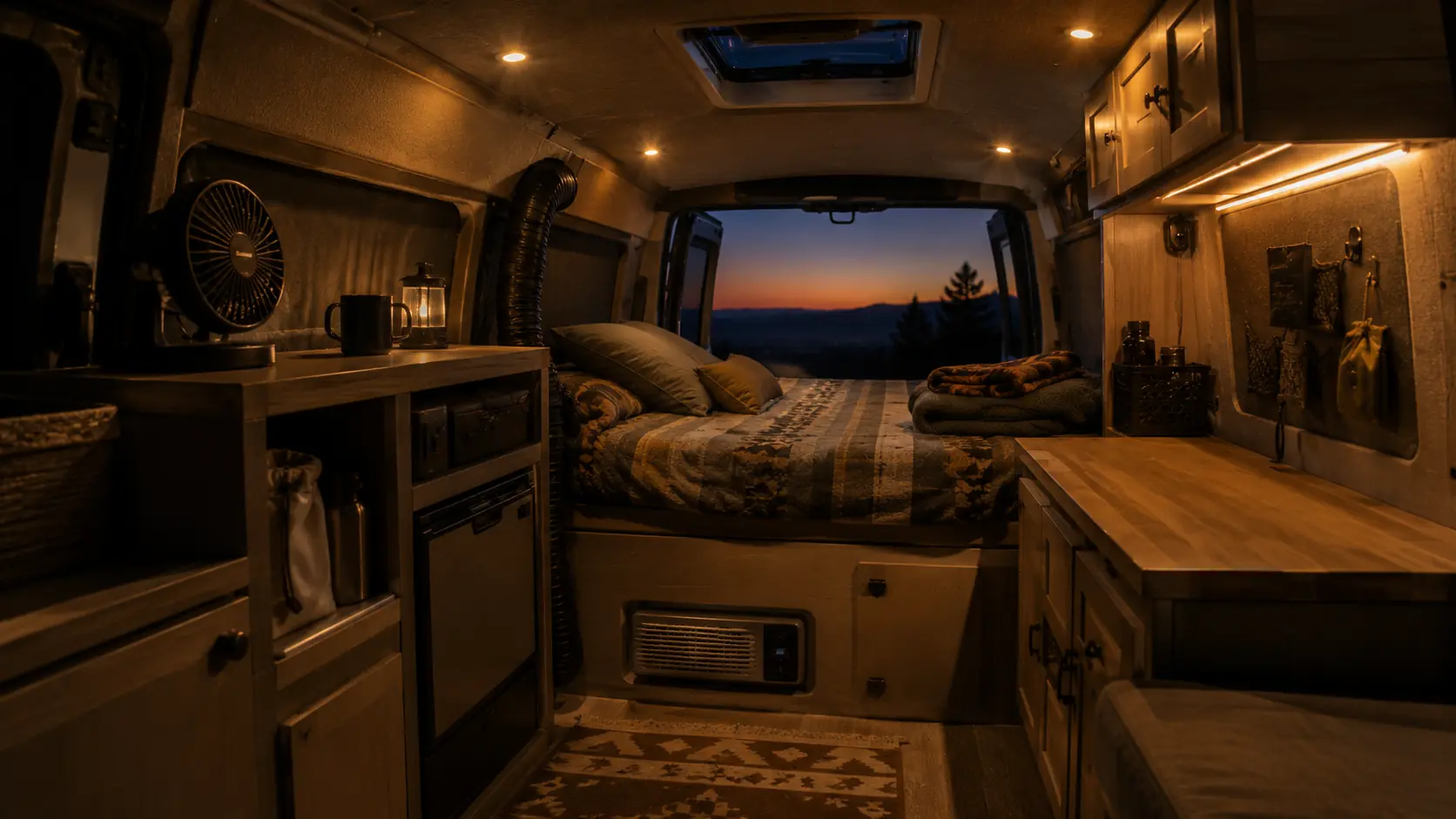
Read together, those three lines say the rating is for a ventilated indoor space that someone awake is supervising. A sealed car with the windows up while you sleep is neither. That gap between how the product is marketed and how it is rated is the whole reason this page exists.
The ventilation arithmetic, before any product
Three numbers decide whether a heater belongs in your space, and you can work all three out in about two minutes.
1. Your cabin volume
Length × width × height, in feet, of the space you actually seal at night. Rough figures, so you can locate yourself:
- SUV cargo area, seats down: roughly 6 ft × 4 ft × 3 ft = about 72 cubic feet.
- Two-person ground tent: roughly 7 ft × 5 ft × 3.5 ft average height = about 120 cubic feet.
- High-roof cargo van conversion: roughly 10 ft × 5.5 ft × 6 ft = about 330 cubic feet.
2. The heater's rated input against that volume
The Portable Buddy's manual gives an input rating of 4,000 BTU/hr on low and 9,000 BTU/hr on high. Put the low setting into the SUV figure above and you are running roughly 55 BTU/hr into every cubic foot of the space you are breathing. In the van it is about 12. The same heater on the same setting is a fundamentally different proposition in those two vehicles, and no product page will tell you that, because the product page does not know your vehicle.
We are not going to convert that ratio into a carbon monoxide concentration. That conversion depends on combustion completeness, air exchange rate, and altitude, and producing a number for it would require a CO meter and a measured cabin - which we do not have. What the ratio does tell you honestly is which direction the risk moves: smaller space, same heater, worse.
3. The fresh-air opening the manufacturer requires
Nine square inches, minimum, for the Portable Buddy. That is a 3″ × 3″ hole, and it is a floor, not a target - the manual's own phrasing is "minimum for adequate ventilation." In practice that means two openings on opposite sides of the space, not one, because a single opening does not create cross-flow. Nine square inches of window gap in an SUV is roughly a finger's width down each of two windows.
It is also the point where the whole plan collapses in the weather that made you want a heater. If it is raining sideways or blowing at 20 mph, you will want that gap shut. That is the moment people get hurt. The ventilation side of the same problem covers how to move air out without opening the vehicle to the weather.
What an ODS does, and what it misses
Every indoor-rated heater here carries an oxygen depletion sensor. It is a genuinely good safety device and it is routinely misunderstood.
- What it does: it monitors the pilot flame, and when the oxygen concentration around it drops, the flame changes shape, the thermocouple cools, and the gas valve shuts. It is a mechanical response to low oxygen.
- What it does not do: it does not detect carbon monoxide. Those are different molecules and the ODS is not looking for CO. A heater that is producing CO because a burner is dirty or partially blocked can keep running with the ODS perfectly satisfied.
- What altitude does to it: the manual states that above 7,000 ft the unit may not burn as brightly and may shut off, needing fresh air and a five-minute wait before relighting. That is the ODS reading thinner air the way it reads a depleted room. It means high-altitude camping gives you nuisance shutdowns, and it also means the sensor's margin is being consumed by altitude rather than by your ventilation.
A CO alarm is not optional
If you run any combustion appliance in an enclosed space, a battery-powered carbon monoxide alarm goes in with it. Not a smoke alarm; those detect a different thing. The CDC's guidance is the standard we follow here: carbon monoxide is colourless and odourless, the early symptoms are indistinguishable from being tired and cold, and people die in their sleep because the symptoms do not wake them.
- Placement: at roughly head height where you sleep, not on the floor and not at the ceiling. CO mixes fairly evenly with air, so what matters is that it is measuring the air you are breathing.
- Type: battery-powered and portable, with a digital readout if you can get one. A readout tells you a level is rising before the alarm threshold; a bare alarm only tells you when it is already a problem.
- Test it before the trip, and replace it on the schedule printed on the unit. Sensors expire whether or not the alarm has ever sounded.
How we handle safety claims we cannot test explains why this page cites manuals and public-health sources rather than publishing its own numbers.
Who should not buy one at all
A meaningful share of the people reading this should leave without a heater, and saying so is more useful than a fifth product recommendation.
- Anyone sleeping in a sealed passenger car. The volume is small, the ventilation you can create is limited, and the manual's own wording - "recreational or commercial enclosure with a window or roof vent" - does not describe a sedan with the windows up.
- Anyone who will not fit a CO alarm. Not a judgement, just a condition of the purchase.
- Anyone who wants heat while they are asleep. The manufacturer says never; we are not going to contradict the manufacturer on the highest-stakes question on the page. If you genuinely need overnight heat in a sealed space, the answer is a vented diesel air heater whose combustion chamber is sealed from the cabin and exhausts outside, not a propane radiant heater with a bigger vent.
- Anyone camping above about 7,000 ft who is expecting reliable operation. Plan for shutdowns.
The cheaper and safer alternatives
Before spending on combustion, spend on insulation. These have no carbon monoxide risk at all, and for most cold-weather car camping they are the actual answer.
- Insulation from below. You lose more heat into the vehicle floor than out of the windows, and it is the cheapest thing to fix - insulation from below, which is usually the cheaper fix covers R-value against overnight lows.
- A sleeping bag rated below the forecast. Bag ratings are survival-oriented rather than comfort-oriented, so a bag rated ten degrees below the expected low is the honest way to buy one.
- Insulated window covers. Glass is the coldest surface in the vehicle and the place condensation forms. Reflectix panels cut to shape cost little and address heat loss and privacy at once.
- A hot water bottle at the foot of the bag. Unglamorous, works, and the water is boiled on a stove outside the vehicle.
How we picked
A camping propane heater has to clear four gates: it has to be sized to the space (an 18,000 BTU heater in a 6 ft tent is a CO problem, a 4,000 BTU heater in a 10x20 ft awning is a coat), it has to be indoor-rated if you use it in an enclosed space, it has to include automatic low-oxygen and tip-over shutoffs, and it has to be quiet enough to keep using.
We do not rank propane heaters by output alone. Output is half the safety equation. A 4,000 BTU heater run safely is dramatically better than an 18,000 BTU heater run badly. Every pick below names the space it is sized for and the safety features that make it safe in that space.
| Product | BTU range | Indoor rated | Best for | Price | Main tradeoff | Where to buy |
|---|---|---|---|---|---|---|
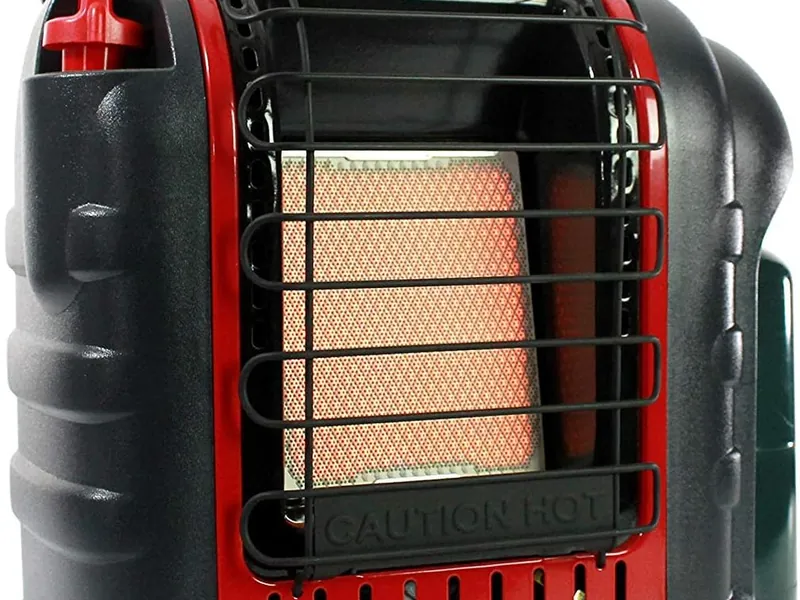 | 4,000-9,000 BTU | Yes (with ventilation) | Small tents, awnings, single-person sleeping spaces | $80-$110 | Single 1 lb cylinder runs about 3-5 hours on low | Check price |
| | 4,000-18,000 BTU | Yes (with ventilation) | Two-person tents, truck campers, larger spaces | $140-$200 | Bulkier; needs two 1 lb cylinders or 20 lb hose for long trips | Check price |
| | 3,200-6,000 BTU | Yes (catalytic, flameless) | RVs, truck campers, vans wanting silent flame-free heat | $280-$340 | Permanent mount or stand purchase; not standalone-portable | Check price |
| | About 3,000 BTU | No (outdoor / vented only) | Awnings, kitchen prep areas, short outdoor sessions | $30-$50 | Outdoor use only - never inside any enclosed space | Check price |
Propane heater picks compared
Best small-space camping heater
Mr. Heater Portable Buddy
$80-$110
- BTU range
- 4,000-9,000 BTU
- Indoor rated
- Yes (with ventilation)
- Best for
- Small tents, awnings, single-person sleeping spaces
- Main tradeoff
- Single 1 lb cylinder runs about 3-5 hours on low
Best larger-space tent and truck-camper heater
Mr. Heater Big Buddy
$140-$200
- BTU range
- 4,000-18,000 BTU
- Indoor rated
- Yes (with ventilation)
- Best for
- Two-person tents, truck campers, larger spaces
- Main tradeoff
- Bulkier; needs two 1 lb cylinders or 20 lb hose for long trips
Best flameless catalytic heater for RVs and truck campers
Camco Olympian Wave 6
$280-$340
- BTU range
- 3,200-6,000 BTU
- Indoor rated
- Yes (catalytic, flameless)
- Best for
- RVs, truck campers, vans wanting silent flame-free heat
- Main tradeoff
- Permanent mount or stand purchase; not standalone-portable
Best entry-tier outdoor heater
Texsport Portable Propane Heater
$30-$50
- BTU range
- About 3,000 BTU
- Indoor rated
- No (outdoor / vented only)
- Best for
- Awnings, kitchen prep areas, short outdoor sessions
- Main tradeoff
- Outdoor use only - never inside any enclosed space
Top picks
Best small-space camping heater
Mr. Heater Portable Buddy
- Best fit Small tents, awnings, single-person sleeping spaces, ice-fishing huts
- BTU range 4,000-9,000 (low to high)
- Run time About 5 hr on low / 2.5 hr on high per 1 lb cylinder
The Mr. Heater Portable Buddy is the camping heater most people should buy first. It is rated by the manufacturer for indoor use with adequate ventilation, includes the same automatic low-oxygen shutoff and tip-over shutoff as the larger Big Buddy, and runs on the same 1 lb green propane cylinders that every gas station and camping store sells. The radiant front panel warms a 4-6 ft area in front of it almost immediately.
The reason it is not the only pick is its size. A 4-6 person tent or a four-wall awning is too much volume for the Portable Buddy to bring up to comfort. For larger spaces step up to the Big Buddy. For long trips, the optional 12 ft propane hose plus a 20 lb refillable tank cuts your fuel cost dramatically and reduces 1 lb cylinder waste.
What works
- Indoor-rated (the rare camping heater that legitimately is)
- Automatic low-oxygen shutoff
- Automatic tip-over shutoff
- 1 lb cylinders sold at every gas station and outdoor store
What to weigh
- Single cylinder lasts only 2.5-5 hr depending on setting
- Not big enough for a 4-person tent or larger awning
- Low-oxygen shutoff triggers reliably above 7,000 ft - by design, but inconvenient at high-altitude sites
Skip if: You need to heat a 4-person tent or larger - step up to the Big Buddy.
Best larger-space tent and truck-camper heater
Mr. Heater Big Buddy
- Best fit Two-person tents, truck campers, small canvas tents, vans
- BTU range 4,000-18,000 (low / medium / high)
- Run time About 7 hr on low / 3.5 hr on high per 1 lb cylinder; ~110 hr from a 20 lb tank
The Big Buddy is the same indoor-safe radiant design as the Portable Buddy at roughly double the output and dual cylinder ports. The three-setting burner (low / medium / high) lets you size output to the actual space - which is the entire safety story. A two-person tent on a 40 F night sits comfortable on the low or medium setting; the high setting is for very cold mornings or larger canvas tents.
The optional electric fan makes the Big Buddy dramatically more useful in any space larger than 8 x 8 ft because it pushes warm air across the volume instead of letting it stratify near the heater. Pair that with a 20 lb refillable tank and a 12 ft propane hose and you have heat for an entire weekend on one fill.
What works
- Three settings cover small to large enclosed spaces
- Dual 1 lb ports OR external 20 lb tank via accessory hose
- Optional fan circulates warm air for bigger volumes
- Indoor-rated with full safety shutoffs
What to weigh
- Bulkier and heavier than the Portable Buddy
- Single-cylinder runtime on high is only 3.5 hr
- Optional fan needs four D-cell batteries or a USB power source
Skip if: You only need to heat a small tent or single-person sleeping area - the Portable Buddy is lighter and cheaper for that use.
Best flameless catalytic heater for RVs and truck campers
Camco Olympian Wave 6
- Best fit RVs, truck campers, vans wanting silent flame-free heat
- BTU range 3,200-6,000 (manually adjusted via valve)
- Run time About 30 hr per gallon of propane at average output
The Camco Olympian Wave 6 is the heater you buy when you live in your camper for weeks at a time and the open-flame Mr. Buddy is too much heater for too short a runtime. The catalytic panel produces heat through a flameless chemical reaction at the catalyst surface rather than an open flame, which means no visible flame, near-silent operation, and the cleaner combustion profile that catalytic heaters are designed for. Camco still rates the unit as requiring fresh-air ventilation and an active CO alarm - clean burn does not mean zero CO.
Two real considerations. The Wave 6 is designed to mount permanently to a wall or to a Camco stand accessory; it is not as portable as the Buddy-series heaters. And the manual valve means there is no thermostat or automatic shutoff except the tip-over and the low-oxygen sensor built into the catalytic platform. Pair it with a separate CO alarm and a programmable thermostat valve (Camco sells one) if you want set-and-forget operation.
What works
- Silent flame-free operation
- Clean catalytic combustion profile (still requires ventilation + CO alarm)
- Long runtime per gallon (about 30 hr at average output)
- Wall-mount option keeps floor space clear in a truck camper
What to weigh
- Mounting accessory adds $40-60
- No thermostat - manual valve control only
- Catalyst panel can be damaged by liquid water or LPG with too much sulfur
Skip if: You need a portable standalone heater you can take from tent to truck camper to friend's RV - the Buddy series is the right format for that.
Best entry-tier outdoor heater
Texsport Portable Propane Heater
- Best fit Awnings, kitchen prep areas, short outdoor sessions
- BTU range About 3,000 BTU
- Run time About 3-4 hr per 1 lb cylinder
The Texsport portable propane heater is what you buy when your heating need is outdoor space - an awning kitchen at dusk, a cold morning prep area, a short evening session before everyone gets in the tent. It is small enough to fit in a daypack, runs on the same 1 lb cylinders as the Mr. Buddy line, and costs less than a third of the Big Buddy.
The non-negotiable limitation: this heater is rated outdoor-use-only. There is no low-oxygen shutoff, no indoor-use certification, and the manufacturer's manual is explicit that it must never be used in any enclosed space, including tents. If you only need outdoor heat, it is the cheapest reasonable option. If you need indoor heat, do not use this; buy the Portable Buddy.
What works
- Lowest-cost portable propane heater we considered
- 1 lb cylinder runs 3-4 hr - enough for an evening session
- Small enough to pack in a daypack
- Works well under an awning or open-air kitchen
What to weigh
- NOT rated for indoor use - tent, vehicle, awning-with-walls all unsafe
- No low-oxygen shutoff
- Build quality is utilitarian; expect 2-4 season lifespan
Skip if: You will use the heater in any enclosed space - the Portable Buddy is the right safety-certified pick for that.
The carbon monoxide rule everyone breaks
Every news story about a camper dying in their sleep from a propane heater shares the same shape: indoor-rated heater, no ventilation, no CO alarm, multi-hour overnight use. The heater itself was usually not the failure. The setup around it was. A battery-powered CO alarm is $25 at any hardware store; pair it with any indoor-rated heater and install it at head-height inside whatever space you sleep in. There is no reasonable trip that justifies skipping this.
Ventilation is the second non-negotiable. Propane combustion produces CO and water vapor, both of which need an exit. A 1-2 inch gap on opposite sides of a tent (door cracked, vent cracked on the opposite side) creates enough air exchange to keep CO under harmful thresholds while still letting the heater warm the space. The 1-2 inch gap costs you almost no warmth and prevents 100 percent of the news stories.
Why we do not recommend overnight propane heat
Most manufacturers state in their own manuals that the heater is not intended for unattended overnight use. The risks are real: CO buildup accelerates as you sleep and stop noticing minor symptoms, propane moisture condenses on cold bedding overnight, and the fuel runs out in 2-7 hours which leaves you cold for the second half of the night anyway.
The reliable cold-weather pattern is: heat the space hot before bed, turn the heater off, sleep in a sleeping bag rated 10 F below the expected overnight low, then turn the heater back on for 20 minutes while you make coffee. If you genuinely need overnight heat in a sealed space (van life in real winter, ice fishing huts), a diesel air heater with proper through-the-roof venting is the safer answer - the heating-cooling hub covers diesel heaters separately.
How the heater fits the whole power and sleep plan
Propane heaters reduce but do not replace your sleep system. A 30 F sleeping bag plus a propane heat-up before bed is more comfortable than a 0 F bag with no heater, and dramatically cheaper. The car camping sleep setup guide covers the bedding pairings that make propane heat actually work, and the car camping pad picks cover the R-value floor that prevents heat loss to the ground regardless of how warm the air is.
A camping fan helps any propane heater by moving warm air across the space instead of letting it pool near the ceiling - see the camping fan guide for the small DC fan that works inside any tent or vehicle. For truck campers and vans considering 12V fridges and diesel heat instead, the lithium battery for RV guide covers the house battery sizing that makes the upgrade work.
What to buy first
If you are buying one heater for a mix of tent and vehicle use, buy the Mr. Heater Portable Buddy plus a 20 ft propane hose, a 20 lb refillable tank, and a battery-powered CO alarm. Total spend around $160-200, and you have a safe indoor heating system for 80 percent of three-season vehicle camping. The Big Buddy is the right upgrade once you know you camp in two-person tents or canvas tents that need more output. The Camco Wave 6 only makes sense after you have a permanent RV or truck-camper install.
And if what you actually took from this page is that a heater is more trouble than it is worth in your vehicle, that is a legitimate outcome. Spend the same money on a pad with a higher R-value, a warmer bag, and window insulation, and you will sleep better with nothing burning next to you.
Frequently asked questions
Is it safe to use a propane heater in a tent?
How long does a 1 lb propane cylinder last?
Why do propane heaters cause condensation?
Do propane heaters work at altitude?
Can I leave a propane heater on overnight?
How we wrote this
A synthesis guide, not a hands-on review
Read this before the picks. We have not run any of these heaters in a vehicle, and this page therefore publishes no measured carbon monoxide concentration, no measured BTU output, and no measured temperature rise. Getting a safety number wrong here could contribute to a real injury, so where we cannot measure, we quote the manufacturer's own manual and the CDC instead, with the source named every time. Every BTU figure on this page is a manufacturer input rating, not a verified output. Where sources disagree, we take the more conservative number. Follow the manual that came with your heater over anything written here.
We have not field-tested every product mentioned. Where we describe a product we are synthesizing manufacturer specifications, independent expert reviews, and verified user feedback from forums. Sections will be replaced with first-hand notes once testing is complete. Read our full methodology.
References
Sources synthesized to write this guide. Manufacturer pages cite specifications; independent publications and forums cite real-world performance and failure patterns.
-
Manufacturer source for the small-space heater (4,000-9,000 BTU) with low-oxygen and tip-over shutoff.
-
The manual itself, and the source for every ventilation, altitude, clearance, and never-while-sleeping figure quoted on this page: 9 sq in minimum vent area, 24 in front clearance, 4,000/9,000 BTU/hr input, and the above-7,000 ft behaviour.
-
Manufacturer source for the larger 4,000-18,000 BTU heater with dual cylinder ports and indoor-safe certification.
-
Manufacturer source for the catalytic flameless heater preferred in RVs and truck campers where flame-free operation matters.
-
Manufacturer source for the budget portable heater that anchors the entry-tier pick.
-
Public-health reference on CO symptoms, alarm placement, and ventilation requirements that all propane heater use depends on.
-
Federal consumer-safety reference on battery-powered CO alarms required for any indoor combustion appliance use.
-
Independent testing used for runtime, warm-up time, and quiet-operation rankings across the format.
-
Owner-reported moisture, fuel-consumption, and altitude-derating failure modes used for the safety section.