Disclosure: Some links on this page are affiliate links. Commissions never change our recommendations. Read the full disclosure.
Last updated
Reviewed May 18, 2026This page covers campers that turn the bed into living space - pop-up and hard-side slide-ins with a bed, a galley, and in most cases a bathroom, at $8,000 to $40,000. If you only want a weatherproof roof over the bed to sleep under, that is a cheaper and lighter purchase: compare truck camper shells and toppers . The Go Fast Campers entry below sits on the boundary and appears on both pages for that reason.
How we picked
A truck bed camper has to clear five gates: it has to fit your truck's payload (wet weight, not dry), it has to fit the bed dimensions, it has to survive the climate you actually camp in, the truck has to still work as a daily driver if that matters, and the build quality has to be worth the price - because none of these are cheap.
That is why this guide picks one camper per buyer profile rather than ranking all four against each other. The Hawk and the Khaya are not competitors; they fit different trucks. The Lance 650 and the Go Fast Camper Platform are not competitors; they answer different questions about what camping should be. Find your profile and the camper picks itself.
| Product | Format | Dry weight | Best for | Price | Main tradeoff | Where to buy |
|---|---|---|---|---|---|---|
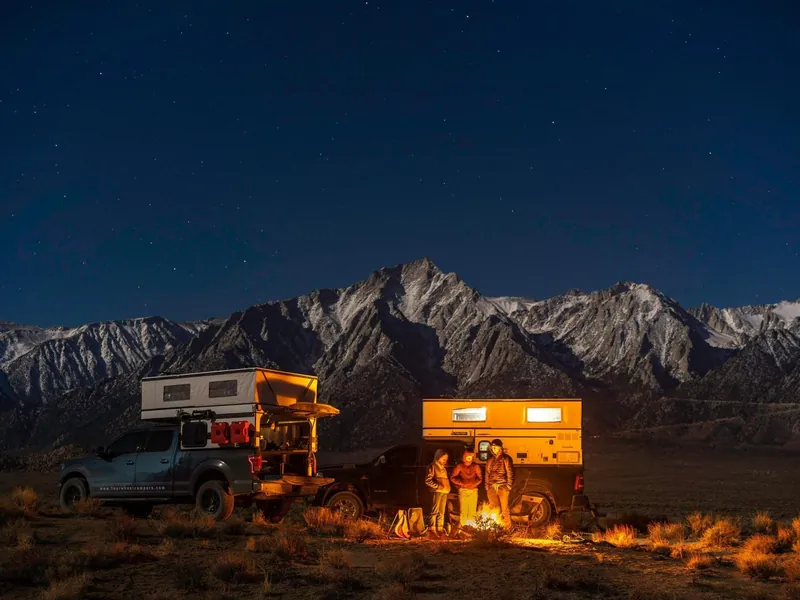 | Pop-up slide-in | About 1,200-1,300 lb | Half-ton and 3/4-ton trucks; year-round expedition use | $32,000-$45,000 base | Pop-up roof means full standing height only when deployed | See it at Four Wheel Campers |
| | Pop-up slide-in (aluminum) | About 660-720 lb | Mid-size trucks with tight payload | $30,000-$38,000 base | Smallest interior of the four; serious overland price tag | See it at Alu-Cab |
| | Hard-side slide-in | About 1,605 lb | Couples on multi-week trips wanting a full bathroom | $32,000-$40,000 base | Hard-side height affects aerodynamics and parking garages | See it at Lance |
| | Topper + sleep platform | About 250 lb | Daily-driver trucks and weekend trips | $8,000-$11,500 plus install | Not an indoor living space; no kitchen, no bathroom | See it at Go Fast Campers |
Truck bed camper picks compared
Best slide-in pop-up for half-ton trucks
Four Wheel Campers Hawk
$32,000-$45,000 base
- Format
- Pop-up slide-in
- Dry weight
- About 1,200-1,300 lb
- Best for
- Half-ton and 3/4-ton trucks; year-round expedition use
- Main tradeoff
- Pop-up roof means full standing height only when deployed
Best slide-in pop-up for mid-size trucks
Alu-Cab Khaya Camper
$30,000-$38,000 base
- Format
- Pop-up slide-in (aluminum)
- Dry weight
- About 660-720 lb
- Best for
- Mid-size trucks with tight payload
- Main tradeoff
- Smallest interior of the four; serious overland price tag
Best lightweight hard-side slide-in
Lance Camper 650
$32,000-$40,000 base
- Format
- Hard-side slide-in
- Dry weight
- About 1,605 lb
- Best for
- Couples on multi-week trips wanting a full bathroom
- Main tradeoff
- Hard-side height affects aerodynamics and parking garages
Best topper-platform camper for daily drivers
Go Fast Campers V2 Pro Topper
$8,000-$11,500 plus install
- Format
- Topper + sleep platform
- Dry weight
- About 250 lb
- Best for
- Daily-driver trucks and weekend trips
- Main tradeoff
- Not an indoor living space; no kitchen, no bathroom
Top picks
Best slide-in pop-up for half-ton trucks
Four Wheel Campers Hawk
- Best fit Half-ton and 3/4-ton trucks; year-round expedition use
- Dry weight About 1,200-1,300 lb base, 1,500-1,800 lb fully optioned
- Bed 6.5 ft full-size mattress with cabover layout
The Four Wheel Campers Hawk is the reference slide-in pop-up because it has been built and refined for 50 years for exactly this market. The pop-up roof drops the highway height to 7 ft 4 in (about half a foot under most hard-sides), the aluminum frame and composite panels keep dry weight under 1,300 lb in base trim, and the interior fits a queen-bed-equivalent with a small kitchen, fridge, and seating dinette.
The case against it is the price. A base Hawk is $32-35k; most owners build to $45-55k with a furnace, solar, lithium, and a hot-water shower. That is real-RV money for a camper without a bathroom. The reason owners pay it is reliability: 20-year-old Hawks routinely change hands at 60-70 percent of new price on Expedition Portal.
What works
- Lowest highway profile of any full slide-in camper
- Aluminum frame holds up to washboard and trail abuse
- Roughly 1,200 lb base fits real half-ton payload
- Strong dealer network and 50-year build history
What to weigh
- Base price is real-RV territory
- Pop-up roof must be deployed for standing height
- Wet bath option is small; many owners skip it for a portable shower
Skip if: You need a full bathroom, you camp in -10 F winter, or you cannot tolerate the build wait (12-24 months for new from factory).
Four Wheel Campers does not sell through Amazon and we are not in their affiliate programme, so this is a plain link to the product page. We earn nothing if you buy it.
Best slide-in pop-up for mid-size trucks
Alu-Cab Khaya Camper
- Best fit Tacoma, Colorado, Ranger, and short-bed half-ton trucks with tight payload
- Dry weight About 660-720 lb base
- Bed Queen mattress in cabover; sleeps 2-4 with optional bunks
The Khaya is what you buy when you love the Hawk but drive a mid-size truck that cannot legally carry 1,200+ lb of camper plus passengers, water, and propane. The Alu-Cab aluminum shell drops base dry weight to 660-720 lb - lighter than some hard-shell rooftop tents - which leaves real payload margin on a Tacoma or Colorado.
The tradeoff is interior size: the Khaya feels noticeably smaller than the Hawk because the smaller truck bed it lives on is smaller. There is no full kitchen indoors; most owners cook on a tailgate stove or pull-out drawer. Owners who tried both the Hawk and the Khaya consistently say the Khaya is the right answer for the truck they actually own, even if the Hawk has the better interior.
What works
- Lightest credible slide-in pop-up; fits mid-size trucks legally
- Aluminum build well-suited to dust and trail vibration
- South African design with serious overland heritage
- Lower roof height when packed makes it the easiest camper to park daily
What to weigh
- Smaller interior than the Hawk
- Kitchen lives outside (tailgate or drawer)
- Limited US dealer footprint; check service access before buying
Skip if: You drive a half-ton or larger truck - the Hawk has more interior space for similar money.
Alu-Cab does not sell through Amazon and we are not in their affiliate programme, so this is a plain link to the product page. We earn nothing if you buy it.
Best lightweight hard-side slide-in
Lance Camper 650
- Best fit Half-ton trucks; couples on multi-week and four-season trips
- Dry weight About 1,605 lb
- Bed Queen cabover; wet bath; full kitchen with three-way fridge
The Lance 650 is the lightest hard-side slide-in that still includes a wet bathroom and a full kitchen with a three-way fridge. At about 1,605 lb dry it fits real half-ton payload margins (F-150, Ram 1500, Silverado 1500, Tundra) with room left over for water and propane. The hard-side walls make it dramatically warmer than any pop-up in winter and faster to set up at camp - park, drop the jacks, plug in, sleep.
The honest counter-argument is height and dynamic feel. The 650 is 9 ft 9 in tall on the truck, which excludes most parking garages and adds real crosswind sensitivity on the highway. Owners who switch from a Hawk pop-up to a Lance hard-side report better winter comfort but worse fuel economy and noticeably more head-checking before driveways and underpasses.
What works
- Wet bathroom included in a half-ton-compatible camper
- Hard walls are dramatically warmer in winter than any pop-up
- Lance build quality and dealer network are strong
- Full furnace, three-way fridge, water tank, and sink in base trim
What to weigh
- 9 ft 9 in height affects parking and crosswind feel
- Heavier than equivalent pop-ups by 300-600 lb
- Daily-driving the truck with the camper on is impractical for most owners
Skip if: You drive a mid-size truck (payload will not work) or you do not need a bathroom and kitchen and would rather have the lower profile of a pop-up.
Lance does not sell through Amazon and we are not in their affiliate programme, so this is a plain link to the product page. We earn nothing if you buy it.
Best topper-platform camper for daily drivers
Go Fast Campers V2 Pro Topper
- Best fit Half-ton and mid-size trucks that are daily drivers first, campers second
- Dry weight About 250 lb
- Bed Pop-up rooftop tent platform (queen); bed below remains usable for cargo or a second sleeping area
GFC's topper is the right answer when the truck is still a daily driver and you do not want a full camper sitting on the bed Monday through Friday. The aluminum topper bolts to the bed rails (250 lb installed) and stays year-round, and the integrated pop-up sleep platform on top gives a queen-bed equivalent without sacrificing the bed below to a camper. Note the naming: GFC has retired the Platform Camper label and the current equivalent product is the V2 Pro Topper, so older reviews and forum threads describing a Platform are discussing this line.
What you give up: there is no indoor living space, no kitchen, no bathroom, no heater, no water tank. This is a topper that sleeps two on top - effectively a rooftop tent that is integrated into the topper instead of bolted onto it. For weekend warriors, that is the entire point. For long-trip campers, it is not enough.
What works
- Lightest pickup-camper format by an order of magnitude
- Truck stays usable as a daily driver year-round
- Roof rated for 600 lb static (rooftop solar, kayaks, ladder)
- Lowest price-to-camper ratio of the four picks
What to weigh
- No indoor living space, no kitchen, no bathroom
- Sleep is on the topper roof, not in the bed
- Cold-weather use needs an under-quilt or thick pad in the rooftop tent
Skip if: You want indoor space when the weather goes bad, or you need a kitchen and water for trips longer than 3-4 days.
Go Fast Campers does not sell through Amazon and we are not in their affiliate programme, so this is a plain link to the product page. We earn nothing if you buy it.
Payload math before brand-shopping
The biggest mistake new truck-camper buyers make is shopping on dry weight. Dry weight does not include water (8.3 lb per gallon), propane (4.2 lb per gallon), food, batteries, solar, the awning, or you. A Hawk quoted at 1,250 lb dry leaves the lot at 1,650-1,900 lb wet. A Lance 650 quoted at 1,605 lb dry routinely weighs 2,000-2,300 lb wet at a CAT scale. Buy by wet weight, not dry.
The yellow payload sticker on your driver-door jamb is the truck's maximum cargo capacity including passengers, fuel, and anything in the cab. Subtract about 200-400 lb for two adults plus fuel and dogs and that is the camper budget. If your truck shows 1,400 lb on the sticker and the camper weighs 1,700 lb wet, the truck is over GVWR every trip - which is not just a fine if you get pulled over, it is a real safety issue at the rear axle weight rating (GAWR). The truck camper shell guide covers the payload math in more detail for owners deciding between a shell and a full camper.
Climate decides format more than budget
If you camp in three seasons, a pop-up camper (Hawk, Khaya) is more comfortable than a hard-side at the same price point because the lower roof profile makes the truck drive normally. If you camp in real winter - consistent overnight temperatures under 25 F, snow on the camper roof - a hard-side with a forced-air furnace is the dramatically more comfortable answer. Pop-ups can heat to comfortable in winter with a diesel heater (covered in our heating-cooling hub), but the canvas pop-up walls always feel like canvas pop-up walls in a blizzard.
Topper-platform builds like the Go Fast Camper occupy a third category entirely: they are basically rooftop tents on a topper, so the sleep surface is well-insulated but there is no living space at all. That is perfect for weekenders who want camp to be a sleep stop, not a basecamp.
How the camper fits the whole vehicle plan
A truck-bed camper is a sleep system, kitchen, power system, and bathroom all on top of one truck, and every one of those systems has its own decision page on this site. For mattresses (most campers ship with a thin foam slab that owners replace), see the truck camper shell guide which covers mattress fitment by truck bed length. For 12V fridges that replace the camper's stock three-way unit, see the heating-cooling hub. For battery and solar planning, see the best portable power station guide or the lithium battery for RV guide if you are building permanent house power.
Awnings, drawer systems, and recovery boards extend a truck camper into a real basecamp; the vehicle awning guide covers the shade and rain-protection side. And if you sleep better in a roof tent than in the cabover bed, the rooftop tent guide covers the alternatives at a fraction of the camper's price.
What to buy first
If you are confident you will camp 30+ nights a year for at least three years, buy the Four Wheel Campers Hawk or Alu-Cab Khaya depending on your truck. The price-per-night math works out, the resale is strong, and the build quality outlasts the truck. If you camp 10-20 nights a year and want the truck to keep being a daily driver, the Go Fast Campers topper is the right entry point. The Lance 650 fits the narrow buyer profile of half-ton owners who want full RV amenities in a removable camper - small group, but the camper they want is exactly this one.
If none of these clear your payload, the answer is usually a shell rather than a smaller camper: shells that make a truck bed weatherproof start around a tenth of the weight.
Frequently asked questions
What payload do I need for a truck bed camper?
Pop-up vs hard-side - which should I buy?
Can I remove a slide-in camper from my truck?
What is the difference between a truck bed camper and a truck topper?
How long does a truck bed camper last?
How we wrote this
A synthesis guide, not a hands-on review
This is a synthesis shortlist. We compare published specs, independent reviews, and recurring owner reports; we have not yet completed first-hand multi-week testing on every camper listed. Affiliate links go to Amazon search results so prices stay current. We earn a commission when you buy, never at extra cost to you.
We have not field-tested every product mentioned. Where we describe a product we are synthesizing manufacturer specifications, independent expert reviews, and verified user feedback from forums. Sections will be replaced with first-hand notes once testing is complete. Read our full methodology.
References
Sources synthesized to write this guide. Manufacturer pages cite specifications; independent publications and forums cite real-world performance and failure patterns.
-
Manufacturer source for the reference mid-size slide-in pop-up: dry weight, floor plan, and electrical options.
-
Manufacturer source for the half-ton hard-side slide-in including dry weight and self-contained features.
-
Manufacturer source for the aluminum slide-in pop-up favoured by overland mid-size truck builds.
-
Manufacturer source for the lightweight topper-platform hybrid; weight, height, and roof-rack rating.
-
Industry reference for how to calculate truck payload against camper wet weight, water, and propane.
-
Independent publication focused on slide-in, pop-up, and flatbed campers; used for owner-reported reliability, weather performance, and lifespan signals.
-
Long-term owner reports on Four Wheel Campers, Alaskan, and Lance for failure modes and resale value.
-
Public reference on real-world wet weight verification before a long trip with a loaded camper.